
Missed compressor service appointments cost HVAC businesses thousands in equipment downtime and lost revenue. Inefficient scheduling creates gaps in preventive maintenance, leading to unexpected system failures and emergency callbacks that erode profit margins. For HVAC technicians and maintenance professionals, mastering compressor service scheduling means fewer missed appointments, optimized routes, and reliable system performance. This guide delivers proven scheduling methodologies, software solutions, and best practices to transform your compressor maintenance workflow in 2026.
Table of Contents
- Understanding compressor service scheduling basics
- Advanced scheduling methodologies for optimizing compressor service
- Implementing efficient scheduling with field service management software
- Handling high-use environments and emergency scheduling protocols
- Streamline your compressor service scheduling with FieldSlot
- Frequently asked questions
Key takeaways
| Point | Details |
|---|---|
| Combine scheduling methods | Preventive maintenance works best when mixing calendar, meter, and condition-based approaches for comprehensive coverage. |
| Software reduces missed appointments | Field service management platforms with geo-routing and automated reminders cut no-shows dramatically. |
| Track performance metrics | Monitoring first-time fix rates and PM compliance reveals scheduling gaps and drives continuous improvement. |
| Prevent costly downtime | Proper scheduling saves thousands per hour by avoiding unplanned equipment failures. |
| Prioritize emergency response | Fast scheduling for urgent repairs meets customer expectations and protects retention rates. |
Understanding compressor service scheduling basics
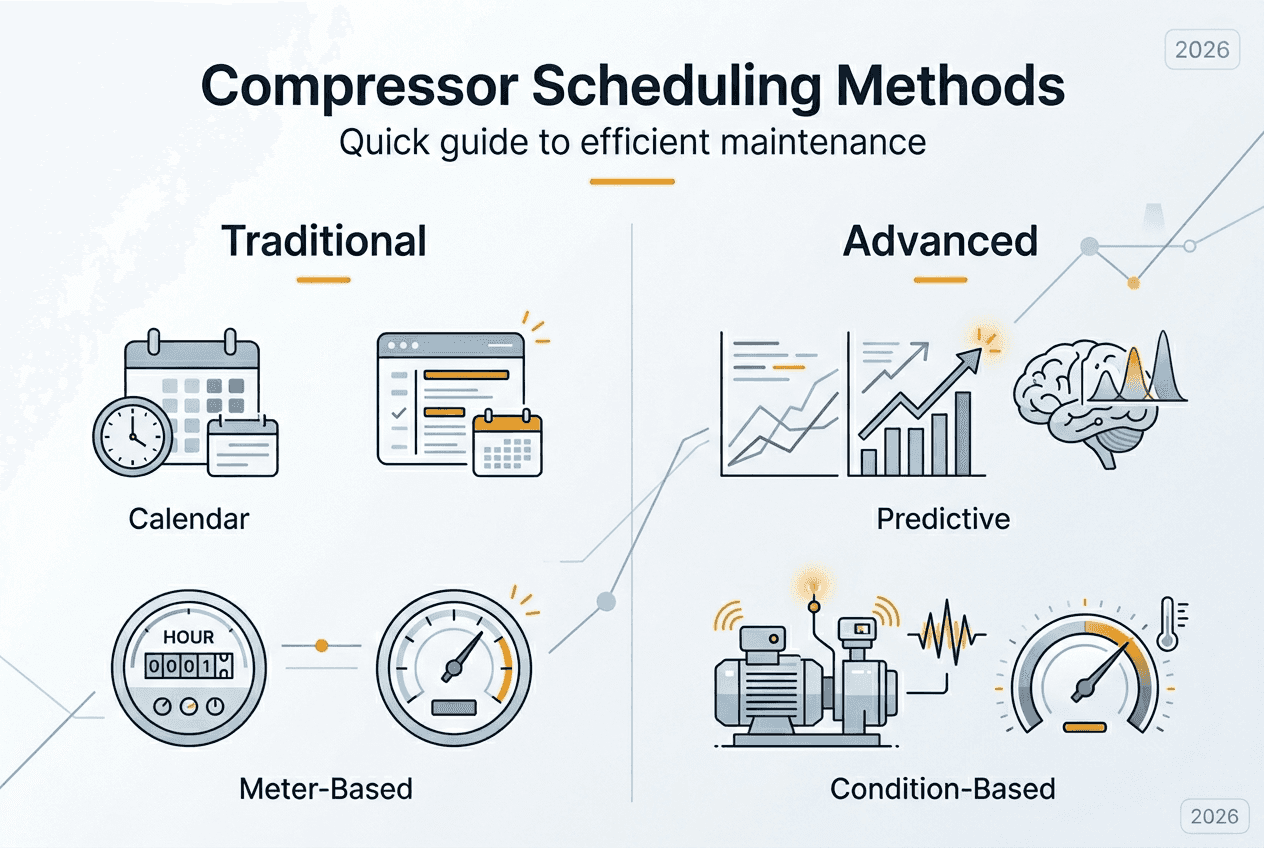
Frequency-based preventive maintenance forms the foundation of effective compressor service scheduling. This traditional approach uses calendar intervals to trigger routine tasks, ensuring equipment receives consistent attention before problems emerge. Compressor service scheduling uses frequency-based preventive maintenance with daily, weekly, monthly, quarterly, semi-annual, and annual tasks.
Here's how standard PM intervals break down:
- Daily checks: Visual inspections for leaks, unusual noises, and pressure gauge readings take five minutes but catch early warning signs.
- Weekly tasks: Belt tension verification, condensate drain inspection, and safety valve testing prevent minor issues from escalating.
- Monthly maintenance: Air filter replacement, oil level checks, and motor bearing lubrication keep systems running smoothly.
- Quarterly service: Coil cleaning, refrigerant level verification, and electrical connection tightening address seasonal wear.
- Semi-annual prep: Comprehensive seasonal readiness inspections before peak cooling and heating demands.
- Annual audits: Full system evaluations including compressor efficiency testing, control calibration, and component replacement planning.
| Task Category | Frequency | Typical Duration | Critical Focus |
|---|---|---|---|
| Visual inspection | Daily | 5 minutes | Leaks, noise, pressure |
| Belt and drain check | Weekly | 15 minutes | Tension, condensate |
| Filter and oil service | Monthly | 30 minutes | Replacement, levels |
| Coil and refrigerant | Quarterly | 60 minutes | Cleaning, charge |
| Seasonal preparation | Semi-annual | 90 minutes | System readiness |
| Full system audit | Annual | 2-3 hours | Efficiency, compliance |
Calendar-based scheduling offers simplicity and predictability, making it easy to plan technician workloads months ahead. However, this approach has limitations. Equipment running 24/7 wears faster than units operating eight hours daily, yet both receive identical service intervals. This mismatch leads to over-maintenance on light-use systems and under-maintenance on heavy-use equipment.
Pro Tip: Use EPA 608 certified checklists during each service visit to ensure compliance with refrigerant handling regulations while capturing detailed maintenance records that protect your business during audits.
Integrating preventive maintenance strategies with your scheduling workflow creates consistency. Set recurring appointments in your calendar system three months out, allowing time to order parts and coordinate with facility managers. This forward planning reduces last-minute scrambling and improves first-time fix rates.
Advanced scheduling methodologies for optimizing compressor service
Modern maintenance strategies move beyond simple calendar intervals by incorporating actual equipment usage and real-time condition data. Advanced methodologies include meter-based, condition-based, and predictive maintenance using sensors to optimize compressor service intervals.
Meter-based scheduling tracks runtime hours and operational cycles rather than calendar days. A compressor logging 2,000 hours in two months needs service sooner than one reaching the same hours over six months. This precision prevents premature maintenance on underutilized equipment while catching wear on heavily used systems before failure occurs. Install hour meters on all compressors and schedule service at specific runtime thresholds: oil changes every 500 hours, filter replacements every 1,000 hours, and comprehensive inspections every 2,000 hours.
Condition-based monitoring takes precision further by measuring actual equipment health through sensor data:
- Vibration analysis: Accelerometers detect bearing wear, misalignment, and mounting issues weeks before audible symptoms appear.
- Oil testing: Laboratory analysis reveals contamination, viscosity breakdown, and metal particles indicating internal wear.
- Temperature trending: Thermal imaging identifies hot spots from electrical problems, refrigerant issues, or airflow restrictions.
- Pressure monitoring: Continuous tracking spots gradual efficiency losses that calendar-based checks miss between visits.
Predictive maintenance represents the cutting edge, using machine learning algorithms to forecast failures based on historical patterns and current sensor readings. These systems analyze thousands of data points, identifying subtle combinations that precede specific failure modes. When vibration increases 15% while oil temperature rises 8 degrees over two weeks, the AI flags an impending bearing failure and automatically schedules service before breakdown occurs.

| Approach | Scheduling Trigger | Accuracy | Initial Cost | Long-term ROI |
|---|---|---|---|---|
| Calendar only | Fixed dates | Moderate | Low | Baseline |
| Meter-based | Runtime hours | High | Low-moderate | 20-30% savings |
| Condition-based | Sensor thresholds | Very high | Moderate | 30-40% savings |
| Predictive AI | Pattern analysis | Highest | High | 40-50% savings |
Pro Tip: Integrate your CMMS with sensor platforms to automatically generate work orders when equipment crosses condition thresholds, eliminating manual monitoring while ensuring timely intervention.
Combining these approaches delivers optimal results. Use calendar intervals as the baseline, meter-based adjustments for usage variations, and condition monitoring to catch anomalies. This layered strategy captured through top booking software for field service reduces unnecessary visits while preventing surprise failures.
Implementing efficient scheduling with field service management software
Field service management platforms transform scheduling from reactive chaos into proactive efficiency. These tools execute the methodologies covered above while solving the practical challenges of coordinating multiple technicians, customers, and service locations. Field service management software reduces missed appointments by optimizing technician assignment, routing, and customer communication while integrating with CMMS for preventive work orders.
Core FSM features that directly impact compressor service scheduling include:
- Drag-and-drop calendars: Visual scheduling interfaces let dispatchers assign jobs in seconds, instantly seeing technician availability and existing commitments.
- Geo-routing optimization: Algorithms calculate the most efficient travel sequences, reducing windshield time by 20-30% while fitting more appointments into each day.
- AI-powered dispatch: Smart assignment considers technician skills, parts inventory, customer priority, and location to match the right tech with each job.
- Automated reminders: Email and SMS notifications sent 24-48 hours before appointments cut no-shows from 15-20% down to 3-5%.
- Real-time updates: Mobile apps sync schedule changes instantly, preventing double-bookings and keeping everyone informed.
Integration between FSM and CMMS platforms creates seamless preventive maintenance execution. When your CMMS generates a PM work order based on runtime hours or calendar intervals, it automatically flows into the FSM scheduler. Dispatchers see the work order details, required parts, estimated duration, and customer location without switching systems. This integration eliminates the manual data entry that causes scheduling errors and delays.
Measurable benefits emerge quickly after FSM implementation. Technicians complete 15-25% more jobs weekly through optimized routing. First-time fix rates improve 10-20% when the right tech with correct parts arrives prepared. Customer satisfaction scores rise as appointment confirmations and arrival notifications reduce uncertainty.
Pro Tip: Enable geo-aware dispatching that automatically assigns emergency calls to the nearest available technician, cutting response times in half while demonstrating responsiveness that drives customer loyalty.
Tracking key performance indicators through FSM dashboards drives continuous improvement:
- PM compliance rate: Percentage of scheduled preventive maintenance completed on time, target 95% or higher.
- First-time fix rate: Jobs resolved in a single visit without callbacks, aim for 85-90%.
- Average response time: Hours from service request to technician arrival, benchmark against customer expectations.
- Windshield time percentage: Travel hours as a portion of total work hours, reduce below 25%.
- Schedule utilization: Productive hours versus available hours, optimize above 75%.
Explore service area setup to save drive time for geographic strategies that complement FSM routing. Review additional optimization tactics through field service booking insights to maximize your scheduling efficiency.
Handling high-use environments and emergency scheduling protocols
Compressors in continuous operation or heavy-use environments demand tighter maintenance schedules than standard calendar intervals provide. Manufacturing facilities, data centers, hospitals, and food processing plants run compressors 24/7, accumulating wear at triple the rate of typical commercial installations. High-use environments require monthly pro service while emergencies prioritized within 24 hours meet the expectations of 74% of customers, and robotics plus AI reduce callbacks from incomplete diagnostics.
Adjust maintenance frequency based on actual operating conditions:
- Continuous operation (20+ hours daily): Monthly comprehensive service, weekly detailed inspections, daily monitoring.
- Heavy use (12-20 hours daily): Service every six weeks, biweekly inspections, daily checks.
- Standard use (8-12 hours daily): Quarterly service with monthly inspections as baseline.
- Light use (under 8 hours daily): Semi-annual service may suffice with quarterly inspections.
Document runtime hours, cycle counts, and operating conditions for each installation to justify schedule adjustments to customers. This data-driven approach demonstrates professionalism while preventing arguments about service frequency and cost.
Emergency scheduling protocols separate successful HVAC businesses from struggling competitors. When a compressor fails during peak cooling season, every hour of downtime costs customers thousands in lost productivity, spoiled inventory, or uncomfortable conditions. Your scheduling response directly impacts customer retention and referral rates.
Follow this emergency scheduling workflow:
- Triage incoming calls: Assess severity, impact, and customer priority within five minutes of contact.
- Check technician availability: Identify who can respond fastest based on current location, skills, and workload.
- Notify affected appointments: Contact customers with scheduled non-emergency work to reschedule if necessary.
- Dispatch with full details: Send technician complete failure symptoms, equipment specs, and site access information.
- Communicate timeline: Give customer realistic arrival estimate and update if delays occur.
- Follow up post-service: Confirm resolution and schedule any needed follow-up work immediately.
Customer expectations for emergency HVAC response have intensified. Nearly three-quarters expect technician arrival within 24 hours, and many demand same-day service for critical failures. Meeting these expectations separates premium service providers from commodity competitors.
AI and robotics integration reduces emergency callbacks by improving diagnostic accuracy. AI-assisted troubleshooting guides technicians through systematic testing sequences, preventing missed root causes that lead to repeat failures. Robotic inspection tools access tight spaces and capture detailed visual data, documenting conditions that human eyes might overlook.
Balance emergency responsiveness with preventive maintenance commitments by maintaining buffer capacity in your schedule. Reserve 15-20% of daily technician hours for unplanned urgent calls rather than booking every minute with routine work. This buffer prevents the cascade effect where one emergency derails your entire day's schedule.
Implement priority-based scheduling tiers: critical emergencies (same day), urgent repairs (next day), routine service (within week), and elective upgrades (flexible). Clear tier definitions help dispatchers make consistent decisions under pressure while setting appropriate customer expectations. Learn more about reducing missed customer calls through systematic communication protocols.
Streamline your compressor service scheduling with FieldSlot
Implementing the scheduling strategies covered in this guide requires tools that match your operational reality. FieldSlot delivers field service management specifically designed for HVAC technicians and maintenance professionals who need efficient compressor service scheduling without enterprise complexity.

FieldSlot's platform combines drag-and-drop scheduling, intelligent geo-routing, and automated customer reminders to reduce missed appointments while maximizing your daily job capacity. Integration capabilities connect with popular CMMS platforms, automatically flowing preventive maintenance work orders into your schedule. Real-time calendar synchronization with Google Calendar and Microsoft Outlook keeps your entire team coordinated across devices.
The platform's geographic service area restrictions prevent unprofitable long-distance calls while route optimization reduces windshield time by up to 30%. Smart travel buffers between appointments prevent the late arrivals that frustrate customers and compress your schedule. Setup takes under five minutes, with no technical expertise required.
Explore the FieldSlot online booking platform to see how 24/7 customer self-scheduling captures more jobs while eliminating phone tag. Review top booking software for field service to understand how FieldSlot compares to alternatives. Check out service area setup tips for strategies that complement the platform's routing intelligence.
Frequently asked questions
How often should compressor maintenance be scheduled?
Standard compressor maintenance follows quarterly intervals for typical commercial use, but actual frequency depends on runtime hours and operating conditions. High-use environments running 20+ hours daily need monthly service, while light-use installations may extend to semi-annual schedules. Track runtime hours and adjust intervals accordingly rather than relying solely on calendar dates.
What causes most missed compressor service appointments?
Poor communication and scheduling conflicts cause 60-70% of missed appointments. Customers forget scheduled service dates without reminders, while technicians face route inefficiencies that create delays. Automated email and SMS reminders sent 24-48 hours before appointments combined with optimized routing reduce no-shows by 75% or more.
Can I combine different scheduling methods for compressor maintenance?
Combining calendar-based, meter-based, and condition-based scheduling delivers optimal results. Use calendar intervals as your baseline, adjust for actual runtime hours, and add condition monitoring to catch anomalies between scheduled visits. This layered approach prevents both over-maintenance and unexpected failures while optimizing service costs.
How quickly should emergency compressor calls be scheduled?
Customer expectations demand same-day or next-day response for emergency compressor failures, with 74% expecting service within 24 hours. Critical facilities like hospitals or data centers may require response within 4 hours. Maintain 15-20% buffer capacity in daily schedules to accommodate urgent calls without disrupting routine maintenance commitments.
What software features matter most for compressor service scheduling?
Prioritize geo-routing optimization to reduce travel time, automated customer reminders to prevent no-shows, and CMMS integration for seamless preventive maintenance work order flow. Mobile apps with real-time sync keep field technicians updated on schedule changes, while drag-and-drop calendars speed dispatcher workflow. Find more optimization strategies at field service booking insights.