
TL;DR:
- Manual scheduling causes double-bookings, missed appointments, and inefficiencies that reduce revenue.
- Automated booking systems streamline appointments, cut no-shows by 60-80%, and save up to 35% more jobs daily.
- Choosing the right software improves efficiency, customer experience, and allows small teams to scale easily.
Many window installation companies still rely on phone calls, paper calendars, and spreadsheets to manage their daily bookings. It feels familiar and controllable. But while you're juggling callbacks and re-routing crews, leading competitors are completing up to 35% more jobs daily using automated booking systems. This guide breaks down exactly why manual scheduling holds window installers back, how automated booking works in practice, and what steps you can take to start seeing real efficiency gains in your own operation.
Table of Contents
- Why window installers struggle with manual scheduling
- How automated booking works for window installation
- Key benefits: Efficiency, more jobs, and happier customers
- Choosing the right automated booking solution
- Most window installers underestimate the real cost of manual scheduling
- Start streamlining your window installation bookings
- Frequently asked questions
Key Takeaways
| Point | Details |
|---|---|
| Save time and reduce errors | Automated booking eliminates manual mistakes and hours lost to repetitive scheduling tasks. |
| Cut no-shows dramatically | Reminders and confirmations from automation can decrease missed appointments by up to 80%. |
| Boost job volume and revenue | Window installers complete up to 35% more jobs daily with integrated scheduling and route planning. |
| Choose the right tool | Comparing features and scalability ensures the solution fits your business size and needs. |
Why window installers struggle with manual scheduling
Manual scheduling has long felt like the safest approach. You control every appointment, every change, every crew assignment. But that control comes at a steep price, and most window installers don't realize how much it's costing them until the problems compound.
Here are the most common scheduling headaches that window installation teams face every week:
- Double-bookings caused by multiple staff members updating separate lists
- Missed appointments when confirmation calls don't go through or get forgotten
- Last-minute cancellations with no automated backup system to fill the slot
- Inefficient routing that sends crews across town when a closer job was available
- Staff bottlenecks where one person handles all scheduling manually, creating a single point of failure
- Poor customer communication that leaves clients unsure whether their appointment is confirmed
These aren't occasional slip-ups. They're structural problems built into the manual process itself. Manual scheduling often leads to more no-shows and wasted drive time, which directly cuts into your daily job count and profit margins.
Customer experience takes the hardest hit. When a homeowner books a window installation and then hears nothing until the morning of the job, anxiety sets in. If the crew arrives late or the wrong time was logged, frustration follows. Even loyal, long-term customers will start looking at competitors if the booking process feels unreliable.
"Even well-run window installation crews can lose a significant portion of their weekly revenue simply because their scheduling process makes it too easy for appointments to fall through the cracks."
Pro Tip: Track how many calls your office handles just to confirm, reschedule, or follow up on existing appointments. For most manual operations, that number is surprisingly high and represents hours of recoverable time each week.
The good news is that the solution doesn't require a massive overhaul. Addressing reducing no-shows starts with the right tools, and improving client scheduling efficiency is far more achievable than most installers expect.
How automated booking works for window installation
Switching to automated booking might sound complex, but the actual process is straightforward once you see it step by step. Here's how a modern automated booking system handles a typical window installation appointment:
- Customer visits your booking page via a link you share on your website, email, or social media.
- They select a date and time from available slots that your system controls based on crew availability and service area.
- The system checks routing to ensure the appointment fits efficiently into the crew's existing schedule for that day.
- Automated confirmation is sent instantly to the customer via email or SMS, with all the details they need.
- Reminders go out automatically 24 to 48 hours before the appointment, reducing the chance of a no-show.
- Your dispatch team gets notified in real time, with the job added directly to the crew's digital schedule.
Automated reminders alone cut no-shows significantly. No-show rates drop 60-80% with consistent automated messaging, which translates directly into more completed jobs per week.
Here's a quick look at how the core components of an automated system work together:
| Feature | What it does | Benefit for window installers |
|---|---|---|
| Online self-booking | Lets customers book 24/7 without calling | Captures jobs outside business hours |
| Route optimization | Sequences jobs by location | Reduces unnecessary drive time |
| Automated reminders | Sends email/SMS before appointments | Cuts no-shows by up to 80% |
| Calendar sync | Connects with Google or Outlook | Keeps crews updated in real time |
| Digital confirmations | Confirms bookings instantly | Builds customer confidence |
Pro Tip: Automated booking isn't just about fewer phone calls. Many platforms integrate with invoicing, CRM, and communication tools, so a confirmed booking can automatically trigger a quote, a deposit request, or a follow-up review message. Think of it as a connected workflow, not just a calendar. Platforms built for HVAC scheduling automation share the same core logic that works well for window installers. Reviewing top field service booking software options will help you spot the integrations that matter most for your workflow.
Key benefits: Efficiency, more jobs, and happier customers
Now that we know how it works, what real, measurable benefits can your window installation business expect from switching to automated booking?
The numbers are hard to ignore. Companies using automated scheduling report completing 24-35% more jobs daily, driven primarily by smarter routing and fewer gaps in the daily schedule caused by no-shows or last-minute changes.
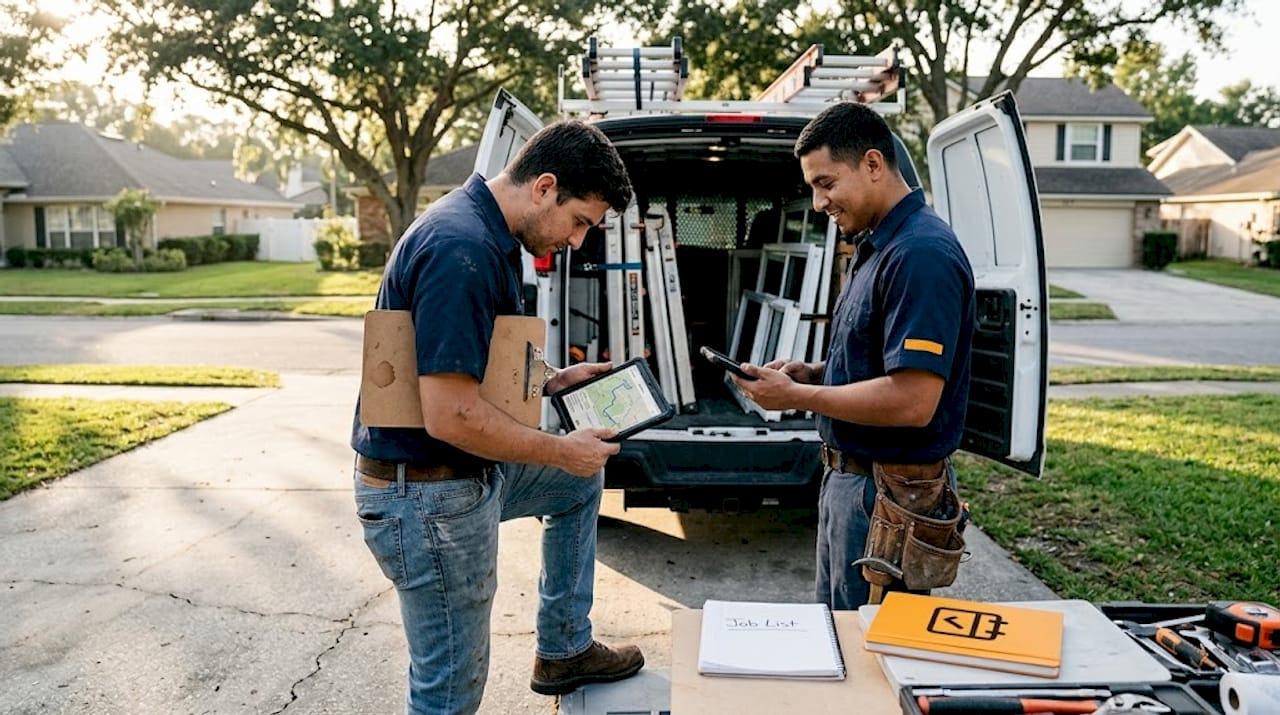
Route optimization is one of the highest-impact features. By sequencing appointments based on location, route optimization saves 45-90 minutes per crew member per day. Over a five-day week, that's up to seven and a half hours of recovered time per crew, which you can fill with additional jobs or use to reduce overtime costs.
Here's how manual and automated booking compare across key performance metrics:
| Metric | Manual scheduling | Automated scheduling |
|---|---|---|
| No-show rate | 15-25% | 3-8% |
| Drive time per crew/day | 90-150 minutes | 45-80 minutes |
| Jobs completed per day | Baseline | Up to 35% more |
| Admin time (scheduling) | 2-4 hours/day | Under 30 minutes/day |
| Customer confirmation rate | Variable | Near 100% |
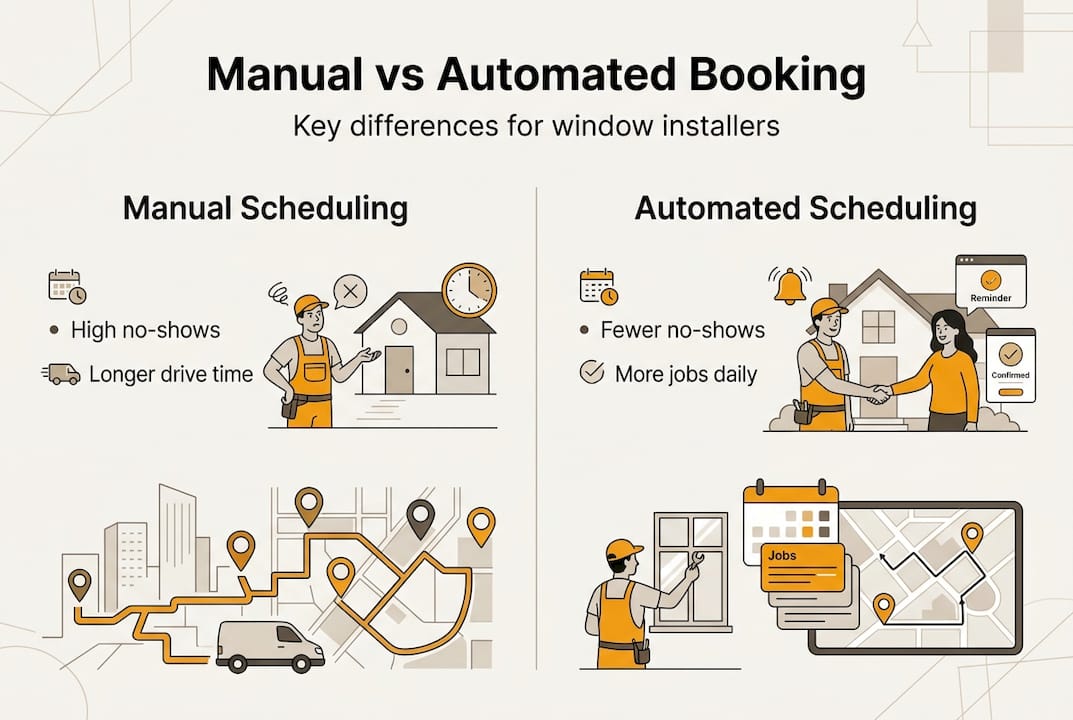
Customer satisfaction improves alongside operational efficiency. When clients receive instant confirmations and timely reminders, they arrive prepared and trust your professionalism. You can track current installation scheduling benchmarks to see how your numbers stack up against industry standards.
For more detail on how these gains apply in practice, the breakdown of route optimization strategies used by similar field service businesses is worth reviewing. You'll also find practical guidance on saving drive time with automation that applies directly to window installation crews.
Choosing the right automated booking solution
To maximize these benefits, selecting the right booking solution is critical. Not every platform fits every operation, and choosing the wrong one can create friction rather than relief.
Start by evaluating these key factors before committing to any software:
- Team size: A solo installer has different needs than a company running five crews simultaneously.
- Existing tools: Look for platforms that integrate with software you already use, such as QuickBooks, Google Calendar, or your CRM.
- Budget: Monthly subscription costs vary widely. Match the feature set to what your operation actually needs.
- Onboarding ease: If setup takes weeks, adoption will suffer. Look for platforms that get you running quickly.
- Mobile access: Crews in the field need real-time schedule updates on their phones, not just desktop access.
Enterprise tools suit large companies but carry high costs; simpler platforms built for small to mid-sized teams deliver faster results at a fraction of the price.
Before you commit to a vendor, ask these questions directly:
- Does your platform support geographic service area restrictions?
- Can customers self-book without calling us?
- Does the system send automated reminders via both email and SMS?
- How does route optimization work, and is it automatic?
- What does setup look like, and how long does it take?
For window installers who want to explore options beyond the most well-known names, reviewing alternative booking software gives you a broader picture of what's available at different price points and feature levels. The right solution should feel like it was built for the way your crew actually works.
Most window installers underestimate the real cost of manual scheduling
Here's what most articles on this topic won't tell you: the resistance to automation isn't really about software cost or learning curves. It's about how familiar the manual process feels, even when it's quietly draining your business.
Manual scheduling isn't just an inconvenience. It's a source of lost jobs, negative reviews, and team burnout that doesn't show up as a line item on your spreadsheet. Every missed call after hours, every double-booked slot, every crew member who starts their day driving the wrong direction represents real revenue that walked out the door.
Companies sticking to manual methods miss over 30% more revenue potential compared to those using automated systems. That's not a marginal difference. That's the gap between a business that grows and one that stays stuck.
The best-run window installation companies we've seen don't ask "what does the software cost?" They ask "what is our current process costing us every week?" That shift in thinking is what drives the decision to automate. Better client scheduling efficiency isn't just about convenience. It's about building a business model that scales without burning out your team.
Start streamlining your window installation bookings
Automated booking can simplify your daily workload, reduce the friction your customers feel, and free your team to focus on installation quality rather than calendar management.

FieldSlot is built for exactly this kind of operation. Whether you're running a small crew or managing multiple teams, FieldSlot gives you online booking that works around the clock, automated reminders, route optimization, and calendar sync with Google and Outlook. Setup takes under five minutes. If you're ready to see what the right tool looks like for your business, start with a review of the best service booking software options available in 2026 and find the fit that works for your crew size and workflow.
Frequently asked questions
How does automated booking decrease no-shows for window installers?
Automated systems send confirmation messages and reminders before each appointment, which reduces no-shows by 60-80% according to industry benchmarks. This keeps your daily schedule full and your crew productive.
Can small window installation companies benefit from booking automation?
Yes. Even a one or two-person operation can recover hours each week and take on more jobs by using a straightforward booking platform. Small to mid-sized operations consistently see strong returns without the complexity of enterprise-level tools.
What features should window installers look for in an automated booking tool?
Prioritize online self-booking, smart route optimization, email and SMS reminders, and integration with your existing tools. The top booking software features for field service businesses align closely with what window installers need day to day.
How quickly can automated booking improve operational efficiency?
Many installers report measurable gains within the first few weeks. Route optimization alone saves 45-90 minutes per crew member per day, which adds up to several additional jobs completed each week.