
TL;DR:
- Schedule furnace repairs in early fall for lower costs and shorter wait times.
- Prepare by noting symptoms, locating furnace details, and clearing access around the unit.
- Use online booking for quick, convenient, and instant appointment confirmation.
When your furnace stops working in January, panic sets in fast. Temperatures drop, repair companies get slammed with calls, and wait times stretch from hours into days. The good news is that scheduling furnace repair does not have to be stressful or expensive. Online booking tools now make it possible to lock in an appointment in minutes, any time of day. This guide walks you through exactly when to schedule, how to prepare, which booking method works best, and what to expect before and after your technician arrives.
Table of Contents
- Understanding when to schedule furnace repair
- Preparation steps before scheduling your repair
- How to book your furnace repair: phone vs. online scheduling
- Managing emergency furnace repairs: what to do and expect
- After booking: confirmation, reminders, and follow-up
- The case for proactive scheduling: what most homeowners miss
- Schedule your next furnace repair with ease
- Frequently asked questions
Key Takeaways
| Point | Details |
|---|---|
| Schedule early for savings | Booking in early fall avoids winter pricing spikes and improves appointment availability. |
| Be prepared before booking | Having system details and access ready saves time and ensures smoother service. |
| Choose online booking for speed | Online platforms offer instant confirmation, lower wait times, and fit into your busy schedule. |
| Know emergency procedures | Use 24/7 services for urgent issues and follow quick safety checks before technicians arrive. |
| Regular tune-ups pay off | Routine maintenance and reminders can extend furnace life and prevent costly breakdowns. |
Understanding when to schedule furnace repair
Timing your furnace repair appointment is one of the most underrated ways to save money and avoid frustration. Most homeowners wait until something goes wrong in the middle of winter. That reactive approach costs more and creates longer waits.
Optimal timing is early fall, specifically September or October, before the heating season peaks. HVAC companies have more open slots, technicians are less rushed, and pricing is often lower. Booking in fall means you get ahead of the crowd before the first cold snap sends everyone scrambling.
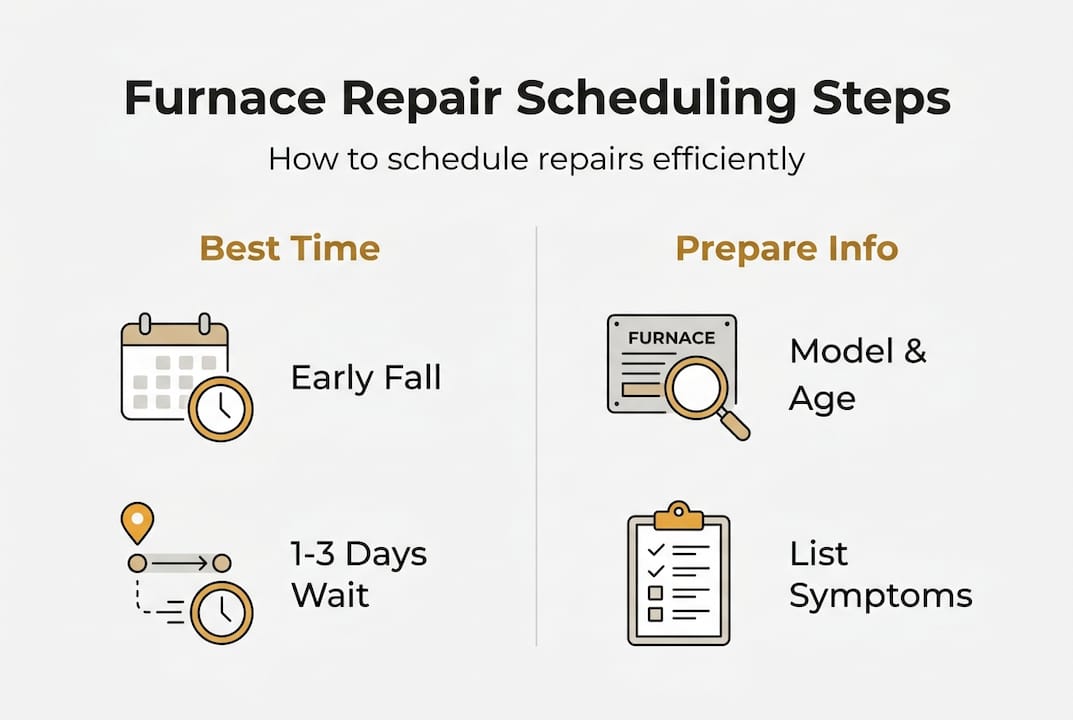
Here is a quick look at how timing affects your repair experience:
| Timing | Availability | Typical wait time | Cost level |
|---|---|---|---|
| Early fall (Sept-Oct) | High | 1-3 days | Lower |
| Late fall (Nov) | Moderate | 3-5 days | Moderate |
| Peak winter (Dec-Feb) | Low | 5-10+ days | Higher |
| Spring (Mar-Apr) | High | 1-2 days | Lower |
The difference between a preventive tune-up and an emergency repair is not just convenience. Preventive repairs can be up to 80% cheaper than reactive fixes because technicians catch small problems before they become major system failures.
Not every furnace issue is an emergency. A furnace that runs but heats unevenly is a non-emergency. A furnace that produces no heat at all when temperatures are below freezing is urgent. Knowing the difference helps you choose the right scheduling path and manage your expectations on response time.
For HVAC businesses, efficient client scheduling is equally important, which is why the best providers now offer flexible booking windows.
Pro Tip: Book your annual furnace checkup in September every year. Set a recurring calendar reminder so you never miss the off-peak window. You will consistently pay less and wait less.
Key situations that call for immediate scheduling:
- Furnace has not been serviced in over 12 months
- You notice unusual sounds, smells, or uneven heating
- Your energy bills have spiked without explanation
- The furnace is over 15 years old
Preparation steps before scheduling your repair
Once you know the right timing, getting fully prepared ensures your appointment goes smoothly. Walking into a booking call or online form without the right information slows everything down and can lead to the wrong technician or wrong parts being dispatched.
Prepare by recording symptoms, noting your furnace details, and clearing at least 3 feet of access around the unit before your technician arrives.
Here is a step-by-step preparation checklist:
- Locate your furnace model and serial number. These are usually printed on a label inside the front panel.
- Note the fuel type. Gas, electric, and oil furnaces require different technician certifications.
- Record all symptoms with dates. When did the problem start? Does it happen constantly or intermittently?
- Check the thermostat battery. A dead thermostat battery mimics a furnace failure and wastes a service call.
- Check the circuit breaker. A tripped breaker is a common, easily fixed issue that does not require a technician.
- Clear 3 feet around the furnace unit. Remove boxes, storage items, and anything blocking access.
- Secure pets and arrange parking. Make the technician's arrival as smooth as possible.
Here is how preparation differs between routine and emergency repairs:
| Preparation item | Routine repair | Emergency repair |
|---|---|---|
| Furnace model and age | Helpful | Essential |
| Symptom log with dates | Helpful | Essential |
| Clear 3-foot access zone | Required | Required |
| Thermostat and breaker check | Yes, before booking | Yes, immediately |
| Pets secured | Recommended | Recommended |
| Parking arranged | Recommended | Required |
"Clear access to the furnace is one of the most important things a homeowner can do. It allows the technician to diagnose faster, work safely, and finish sooner." This is especially true for tight utility rooms or basement installations.
Reviewing HVAC scheduling tips before your appointment can also help you understand what information providers need upfront.
Pro Tip: Before calling or booking online, spend five minutes doing the thermostat battery and circuit breaker checks. These two simple steps resolve roughly 10% of apparent furnace failures without any service call at all.
How to book your furnace repair: phone vs. online scheduling
With your prep list in hand, you are ready to lock in your repair. The two main options are phone booking and online booking. Each has its place, but they are not equal in every situation.
Service providers offer phone and 24/7 online booking with instant confirmation, giving homeowners real flexibility in how they connect with technicians.
Online booking streamlines scheduling and reduces wait times, making it the better option for non-emergency repairs when you want speed and convenience without sitting on hold.
Here is a direct comparison:
| Feature | Phone booking | Online booking |
|---|---|---|
| Availability | Business hours only | 24/7 |
| Confirmation speed | Verbal, then email | Instant |
| Wait time | Hold queues common | None |
| Accuracy | Depends on agent | Standardized form |
| Best for | Complex or urgent issues | Routine and non-emergency |
How to book online through a typical HVAC provider:
- Visit the provider's website and find the booking or scheduling page.
- Select your service type (repair, tune-up, emergency).
- Enter your address and confirm it falls within the service area.
- Choose an available date and time window.
- Fill in your furnace details: make, model, fuel type, and symptoms.
- Submit and receive instant confirmation by email or text.
For online HVAC booking, the best platforms show real-time calendar availability so you know immediately whether your preferred slot is open.
Pro Tip: Use 24/7 online portals whenever possible for non-emergency repairs. You skip hold queues, get instant confirmation, and can book at midnight if that is when you finally notice the problem.
Key information to have ready when booking:
- Full address and preferred contact number
- Furnace make, model, and approximate age
- Brief description of symptoms and when they started
- Preferred appointment window (morning, afternoon, or specific date)
Managing emergency furnace repairs: what to do and expect
Sometimes, your furnace will not wait. When temperatures drop below freezing and your heat goes out, or when you detect a gas smell or your carbon monoxide (CO) alarm sounds, you are dealing with a genuine emergency.
For emergencies such as CO alarms or no heat in cold weather, call or use urgent online booking immediately. Many providers offer same-day slots specifically for these situations.
Immediate safety steps to take during a furnace emergency:
- CO alarm sounding: Evacuate everyone from the home immediately. Call 911 from outside.
- Gas smell detected: Do not touch any switches. Leave the home, leave the door open, and call your gas utility from outside.
- No heat in freezing temperatures: Check the thermostat and breaker first. If those are fine, call for emergency service.
- Furnace producing sparks or smoke: Shut off the power to the unit and call immediately.
"Never wait when a CO alarm activates. Carbon monoxide is odorless and colorless. Treat every alarm as a real emergency, not a false alarm."
How to handle an emergency repair booking:
- Ensure everyone is safe before touching any device.
- Call the provider's emergency line or use their urgent online booking option.
- Clearly state it is an emergency and describe the symptom (CO alarm, no heat, gas smell).
- Follow any safety instructions given while waiting for the technician.
- Do not re-enter the home if a gas leak or CO issue is suspected until cleared by a professional.
For providers focused on optimizing urgent HVAC appointments, real-time dispatch and route optimization mean faster response times for homeowners in critical situations.
Pro Tip: Save your HVAC provider's emergency number and a backup booking app on your phone before winter starts. When it is 2 a.m. and your heat is out, you do not want to be searching for a number.
After booking: confirmation, reminders, and follow-up
Once you have scheduled your repair, a few final steps ensure your appointment goes as planned. The post-booking phase is where many homeowners drop the ball, and missed appointments or last-minute scrambles are the result.
Online systems provide instant confirmation and automated reminders to reduce no-shows and eliminate confusion about appointment times.
What to expect after booking:
- Confirmation email or text: Arrives within minutes of booking. Save it and check the date, time, and service type.
- Automated reminders: Most modern booking systems send reminders 24 to 48 hours before your appointment.
- Technician details: Some providers send the technician's name and estimated arrival window on the day of service.
- Rescheduling options: If your plans change, use the link in your confirmation email to reschedule without calling.
Day-of-visit preparation:
- Keep the area around the furnace clear
- Ensure someone over 18 is home during the appointment window
- Have your symptom notes ready to share with the technician
- Arrange parking for the service vehicle in advance
Using automated HVAC reminders is one of the simplest ways to avoid missed appointments on both sides.
Pro Tip: Automated appointment reminders can cut missed appointments by up to 60%. If your provider does not send reminders, set your own phone alert for 24 hours before the visit.
After the repair, expect a service receipt, a summary of work completed, and recommendations for future maintenance. Keep these records. They are useful for warranty claims and for tracking your furnace's service history.
The case for proactive scheduling: what most homeowners miss
Most homeowners treat furnace repair like car insurance. They hope they never need it and only act when something breaks. That approach is expensive. A $300 preventive tune-up that catches a cracked heat exchanger early can easily save you from a $1,800 emergency repair or a full system replacement.
Tune-ups can extend furnace life by up to 20%, and for older systems, a scheduled checkup is also the right moment to make an honest repair-versus-replace decision before a breakdown forces your hand.
Digital scheduling tools now make proactive maintenance nearly effortless. You can book a recurring annual checkup in under five minutes, receive automated reminders, and never think about it again until the technician shows up. There is no excuse for skipping it.
The pattern we see repeatedly is homeowners who invest in proactive HVAC scheduling spend less over time, have fewer emergencies, and get more years out of their equipment. The homeowners who wait spend more, stress more, and replace systems sooner.
Pro Tip: Commit to a yearly furnace checkup every September. Put it in your calendar as a recurring event. That single habit will extend your furnace's life, improve efficiency, and keep repair costs predictable.
Schedule your next furnace repair with ease
You now have a clear, step-by-step approach to scheduling furnace repair efficiently, from timing and preparation to booking and follow-up. The next step is putting it into practice with a tool built for exactly this kind of seamless experience.

FieldSlot connects homeowners with HVAC technicians through a 24/7 online booking platform that delivers instant confirmation, automated reminders, and real-time calendar availability. No hold queues, no back-and-forth calls. You pick your time, submit your details, and get confirmation immediately. Whether you need a routine tune-up or an urgent repair, FieldSlot makes the booking process fast, clear, and stress-free. Set up takes under five minutes, and the platform works across all devices so you can book from anywhere.
Frequently asked questions
When is the best time of year to schedule furnace repair?
Early fall is ideal for furnace repair, specifically September or October, when availability is high and costs are lower before winter demand peaks.
What information should I have ready before booking furnace repair?
Have your furnace make, model, age, fuel type, and a list of symptoms ready. Report symptoms and furnace details and ensure at least 3 feet of clear access around the unit before the technician arrives.
How do I schedule emergency furnace repairs?
Same-day urgent slots are available through most providers via 24/7 phone or online emergency booking options designed for situations like CO alarms or no heat in freezing temperatures.
What are the benefits of online scheduling for furnace repair?
Online booking reduces wait times and offers real-time availability plus instant confirmation, making it the most efficient option for non-emergency repairs.
What should I do to prepare my home for a furnace repair visit?
Clear at least 3 feet around the furnace unit, secure pets, arrange parking for the service vehicle, and make sure an adult is present during the appointment window.