TL;DR:
- Manual scheduling increases fuel, maintenance, and overtime costs in field service businesses. Implementing route optimization reduces travel time and costs while boosting jobs completed per day. Successful adoption depends on data accuracy, technician trust, and real-time dynamic re-optimization.
Manual scheduling is costing field service businesses more than most managers realize. Manual planning adds 23% to fuel and maintenance costs, and that figure doesn't account for the overtime, missed appointments, and customer frustration that pile on top. If your technicians are still working from hand-built schedules or gut-feel routing, you're leaving real money on the table. This guide breaks down exactly what route optimization is, how it works, what results you can realistically expect, and how to put it into practice without disrupting your team.
Table of Contents
- Understanding route optimization in field service
- Quantifiable benefits: What field service leaders gain from route optimization
- How route optimization works: Algorithms, data, and decision-making
- Practical realities: Challenges and best practices for field service route optimization
- Our take: Why success with route optimization is human as much as technical
- Start optimizing your field service operations today
- Frequently asked questions
Key Takeaways
| Point | Details |
|---|---|
| Huge efficiency gains | Route optimization can cut travel and fuel costs by up to 35 percent for field service firms. |
| Customer service boost | Optimized routes enable more on-time arrivals and a better customer experience. |
| Smart adoption matters | Success depends on both powerful algorithms and team buy-in with explainable results. |
| Best practices reduce risk | Real-time data, ongoing pilots, and KPI tracking help overcome edge cases and adoption challenges. |
Understanding route optimization in field service
Now that we've set the stage, let's break down what route optimization actually means in a real-world field service business.
Route optimization in field service means determining the most efficient paths for technicians to travel between job sites, accounting for distance, traffic, time windows, technician skills, and job priorities to minimize travel time, fuel costs, and late arrivals. It's not just about finding the shortest road between two points. It's about sequencing an entire day's worth of jobs across multiple technicians in a way that makes operational sense.
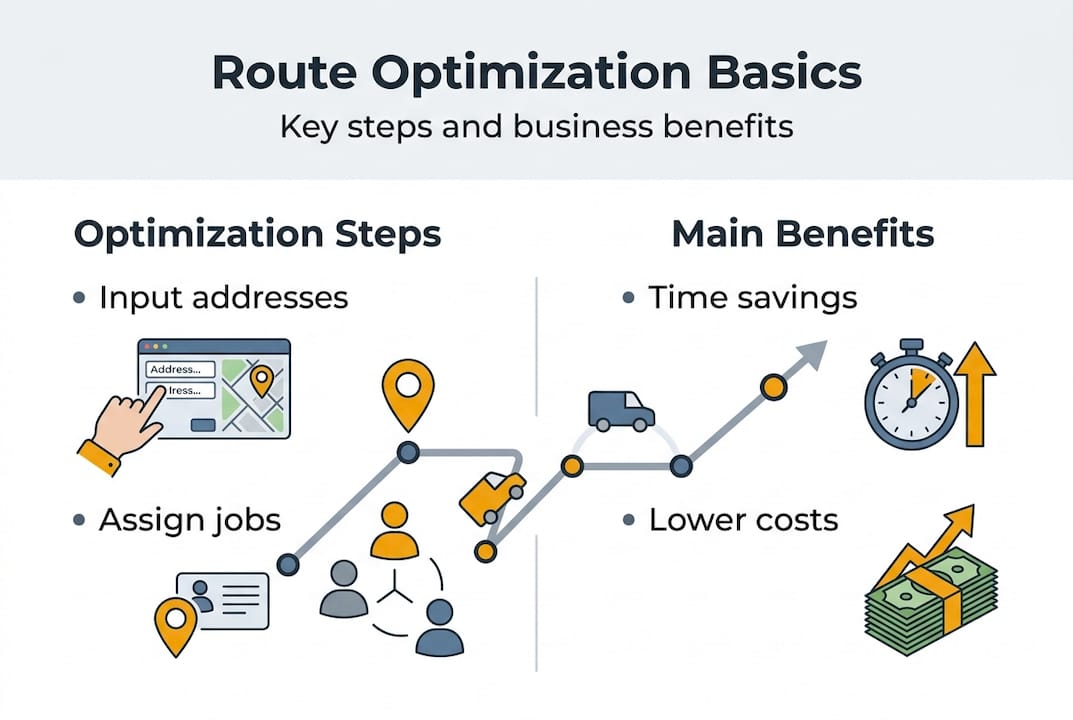
Manual planning breaks down fast. A dispatcher managing five technicians with eight jobs each is already juggling 40 variables before accounting for traffic delays, cancellations, or emergency callouts. Add a sixth technician and the complexity doesn't grow linearly, it multiplies. No spreadsheet or whiteboard can keep up.
Modern route optimization tools factor in a wide range of inputs:
- Traffic and road conditions in real time
- Technician skill sets matched to specific job requirements
- Customer time windows and appointment commitments
- Vehicle capacity and equipment requirements
- Geographic clustering to group nearby jobs efficiently
- Travel buffers to prevent back-to-back jobs from running late
One of the most overlooked benefits is service area control. When you set up service areas correctly in your scheduling software, you prevent technicians from accepting jobs that require unprofitable travel in the first place. That's route optimization working upstream, before the day even starts.
"The goal isn't to find the perfect route. It's to find a route that's good enough to execute reliably, even when conditions change."
This distinction matters. Businesses that chase theoretical perfection in routing often struggle with real-world disruptions. The better approach is building a system that's resilient, adaptable, and easy for your team to follow without second-guessing every decision.
Quantifiable benefits: What field service leaders gain from route optimization
With a clear sense of route optimization's purpose, it's time to see the measurable impacts real businesses experience when they make the switch.
The numbers are consistent across industries and fleet sizes. Route optimization delivers a 20 to 30% reduction in travel time and fuel costs, a 15 to 20% increase in jobs completed per day, reduced overtime, lower emissions, and measurable improvements in customer satisfaction. For a business running 10 technicians, those percentages translate into significant annual savings.

| Metric | Typical improvement |
|---|---|
| Travel time and fuel costs | 20 to 30% reduction |
| Jobs completed per day | 15 to 20% increase |
| Overtime hours | 35% reduction |
| Customer satisfaction score | Measurable uplift |
| Annual savings per 10 technicians | $39,000 |
Field service firms save $39,000 per year for every 10 technicians through optimized routing, while government fleet operators have documented savings ranging from $180,000 to $2.7 million annually. These aren't outliers. They reflect what happens when inefficient routing is replaced with data-driven scheduling.
Statistic to note: A 15% increase in daily job capacity for a team of 10 technicians completing 6 jobs each means 9 additional jobs per day. At an average ticket of $200, that's $1,800 in added daily revenue without hiring anyone new.
Pro Tip: Before investing in route optimization software, calculate your current cost per job by dividing total vehicle and labor costs by jobs completed per month. This gives you a baseline to measure actual ROI after implementation.
For HVAC businesses specifically, smart HVAC efficiency practices show that operational improvements compound quickly when scheduling and routing work together. The same principle applies across plumbing, electrical, and locksmith operations.
Customer satisfaction is another area where the gains are real and measurable. When technicians arrive on time consistently, customer trust builds. Fewer late arrivals mean fewer complaint calls, fewer rescheduled appointments, and higher first-visit resolution rates. To fully realize these gains, you need to optimize appointment scheduling alongside routing, not treat them as separate problems. The scheduling software benefits extend well beyond the dispatch board.
How route optimization works: Algorithms, data, and decision-making
Having seen what's possible, the next question is: how do these systems actually work to deliver on these promises?
At the core of every route optimization engine is a mathematical challenge called the Vehicle Routing Problem, or VRP. The VRP asks: given a set of locations, a fleet of vehicles, and a set of constraints, what's the best way to assign and sequence deliveries or service calls? When you add time windows to the equation, it becomes the VRPTW (Vehicle Routing Problem with Time Windows), which is what most field service tools are actually solving.
The problem is computationally hard. Finding the mathematically perfect solution for even a modest fleet is impractical in real time. Instead, modern optimization tools use metaheuristics including genetic algorithms, local search, simulated annealing, and ant colony optimization to find near-optimal solutions quickly. These approaches don't guarantee perfection, but they consistently find routes that are 90 to 95% as efficient as the theoretical best.
Here's how a typical optimization cycle works:
- Data ingestion: Job addresses, time windows, technician locations, skills, and vehicle details are loaded into the system.
- Constraint mapping: The algorithm identifies hard constraints (must-arrive windows, required skills) and soft constraints (preferred technician, customer requests).
- Route generation: The solver runs thousands of possible route combinations and scores each against the objective function (usually minimizing total travel time or cost).
- Output and assignment: The best feasible routes are assigned to technicians and pushed to their devices.
- Real-time adjustment: As conditions change (traffic, job overruns, cancellations), the system re-optimizes dynamically.
Pro Tip: Look for tools that support dynamic re-optimization, not just static morning planning. A route that was optimal at 7 a.m. may be significantly suboptimal by 10 a.m. if one job runs long.
Real-time data integration including GPS feeds, live traffic APIs, and technician status updates is what separates modern optimization platforms from basic mapping tools. Geographic clustering groups nearby jobs to reduce dead miles. Multi-day planning balances workloads across the week rather than optimizing each day in isolation. To see how this applies directly to your team, explore how to optimize technician routes for maximum daily efficiency.
Practical realities: Challenges and best practices for field service route optimization
No solution is without hurdles; here's what businesses should anticipate and how to avoid the pitfalls.
Route optimization delivers real results, but deployment isn't always smooth. Understanding the common friction points helps you plan a smarter rollout.
Common challenges include:
- Data quality issues: Inaccurate addresses, missing job durations, or outdated technician skill records produce poor routes regardless of algorithm quality.
- Variable travel times: Traffic models are good but not perfect. Unexpected delays can cascade through a tightly packed schedule.
- Skill matching complexity: Assigning the right technician to the right job requires clean, current data on certifications and specializations.
- Workload fairness: Technicians notice when one person consistently gets the worst routes or the most jobs. Perceived unfairness drives resistance.
- Driver resistance: Some technicians prefer their own routing habits and may distrust or ignore system-generated routes.
Edge cases in real deployments include vehicle-specific constraints, real-time disruptions, and the challenge of balancing human factors alongside pure efficiency metrics. These aren't reasons to avoid optimization. They're reasons to plan your rollout carefully.
"The businesses that succeed with route optimization treat it as a process change, not just a software purchase."
Successful adoption requires running pilots before full deployment, integrating the tool with existing scheduling and dispatch systems, and tracking clear KPIs from day one. Change management matters as much as the technology itself.
Best practices for a successful rollout:
- Start with a pilot group of 2 to 3 technicians before scaling
- Clean your job and customer data before going live
- Set clear KPIs: travel time per job, jobs per day, overtime hours
- Involve technicians early and explain how routes are generated
- Review performance weekly and adjust constraints as needed
For practical guidance on structuring your scheduling process, see how to schedule clients efficiently to reduce gaps and maximize capacity.
Our take: Why success with route optimization is human as much as technical
After unpacking the mechanics and best practices, it's time for a frank look at what truly drives sustainable gains in field service optimization.
Most conversations about route optimization focus on the algorithm. Which solver is fastest? Which platform has the best traffic integration? Those questions matter, but they're not what separates businesses that see lasting gains from those that revert to manual planning within six months.
The real differentiator is how well the technology is understood and trusted by the people using it. Prioritizing explainability means designing routes that technicians can understand and accept, not just routes that score well on paper. A route that a technician ignores delivers zero efficiency gains.
Field teams are more likely to follow optimized routes when they can see why a route was built the way it was. When the system accounts for local traffic knowledge, fair workload distribution, and realistic job durations, technicians stop fighting the tool and start trusting it. That trust is what compounds over time into real operational improvement.
The scheduling software benefits you read about in case studies are built on this foundation. Technology provides the capability. Culture and communication deliver the results.
Start optimizing your field service operations today
To put these insights into action, here's where to start with proven technology built for field service professionals.
Route optimization doesn't have to be a complex, months-long project. The right platform makes it accessible from day one.
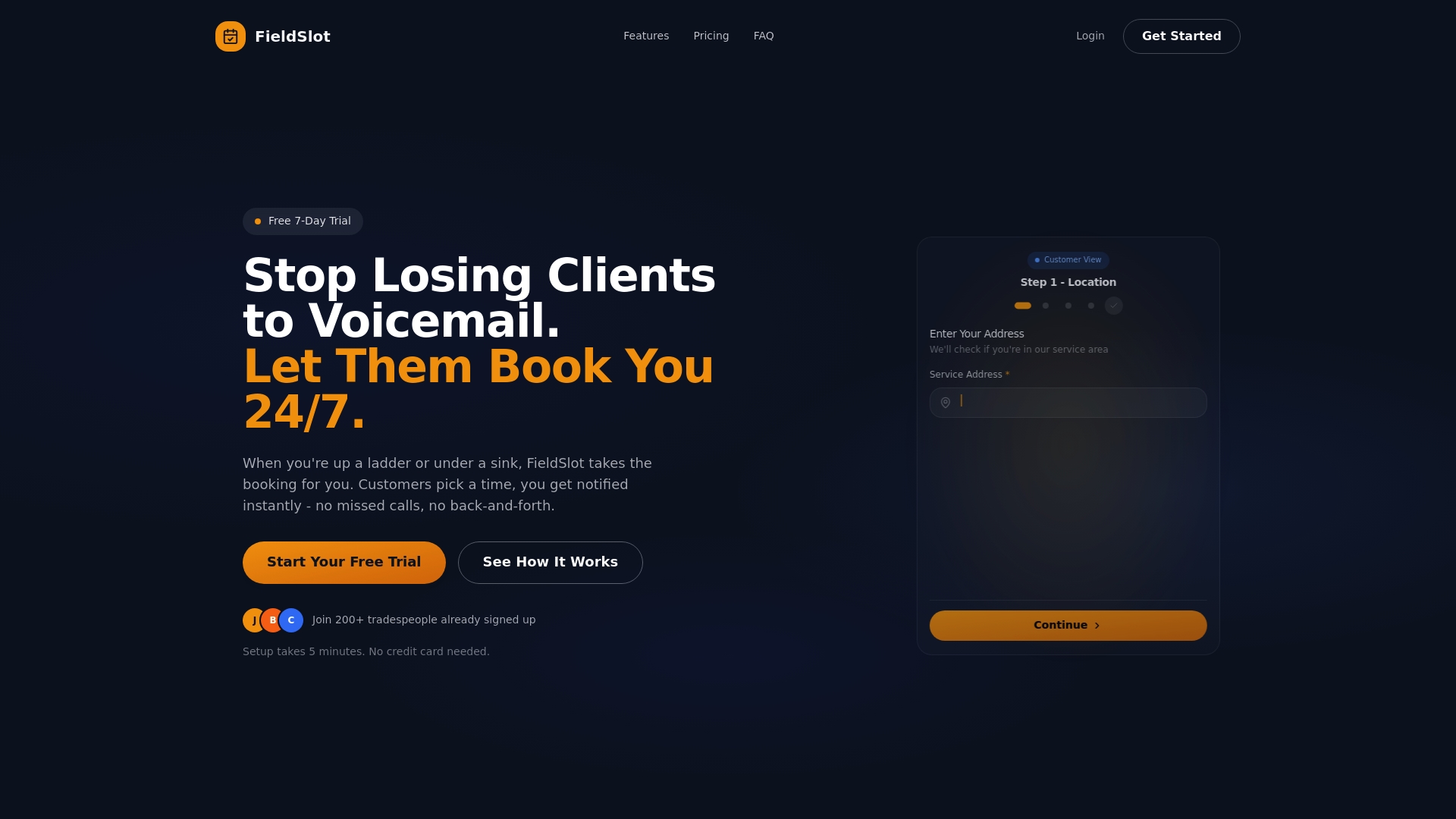
FieldSlot is built specifically for field service professionals including plumbers, electricians, HVAC technicians, and locksmiths. It combines 24/7 online booking, automated reminders, real-time calendar sync, geographic service area controls, and built-in route optimization into a single platform you can set up in under five minutes. If you're evaluating your options, start with a review of the top field service booking solutions to see how FieldSlot compares. Fewer wasted miles, more completed jobs, and better customer experiences are within reach.
Frequently asked questions
What is route optimization in field service?
Route optimization in field service means using software to determine the most efficient travel paths for technicians between job sites, reducing travel time and operating costs.
How much can field service companies save with route optimization?
Firms typically save 20 to 35% in travel and operating costs. Savings reach $39,000 per year for every 10 technicians, with fuel cuts of 22 to 35% and overtime reductions of up to 35%.
Can route optimization really improve customer satisfaction?
Yes. Optimized routing increases on-time arrivals and enables better customer communication, both of which directly improve satisfaction scores and reduce complaint calls.
What data is required for effective route optimization?
Accurate job addresses, technician skill records, customer time windows, vehicle details, and live traffic data are all essential. Real-time GPS and traffic integration is what makes dynamic re-optimization possible.
How do you overcome challenges with driver resistance to new routing tools?
Success requires pilots, KPI tracking, and clear communication about how routes are generated. Technicians adopt new tools faster when they understand and trust the logic behind them.