TL;DR:
- Automated reminders significantly reduce missed maintenance and emergency shutdowns.
- They improve equipment lifespan by ensuring timely servicing and build customer trust.
- Combining automation with human oversight maximizes operational efficiency and service quality.
Compressor failures rarely announce themselves. One missed oil change or a skipped filter inspection is enough to trigger a cascade of problems that halts a job site, damages client relationships, and drains your budget on emergency repairs. Many field service managers assume a basic maintenance calendar is sufficient, but the reality is that manual tracking breaks down under the pressure of busy schedules and high job volumes. Automated reminders change that equation entirely. This guide walks you through the real numbers, the mechanics behind automated systems, and the practical steps to implement them so your compressors stay running and your team stays productive.
Table of Contents
- Why timely compressor maintenance matters
- What automated reminders do: core features and benefits
- Real-world results: downtime reduction and operational gains
- Best practices for implementing automated reminders
- The hidden potential (and limits) of automation in service businesses-of-automation-in-service-businesses)
- Take action with smart scheduling and reminders
- Frequently asked questions
Key Takeaways
| Point | Details |
|---|---|
| Decrease downtime risk | Automated reminders prevent costly compressor shutdowns by keeping maintenance on track. |
| Boost equipment longevity | Properly timed reminders can extend compressor life by as much as 40%. |
| Enhance customer loyalty | Consistent communication with automated emails strengthens relationships and retention. |
| Simplify scheduling | Automation reduces human error and saves time compared to manual scheduling. |
Why timely compressor maintenance matters
Air compressors are the backbone of HVAC, plumbing, and electrical service operations. They power pneumatic tools, pressure testing equipment, and climate systems. When one goes down unexpectedly, it does not just slow a technician down. It can halt an entire job, trigger penalty clauses in service contracts, and push emergency repair costs into the thousands.
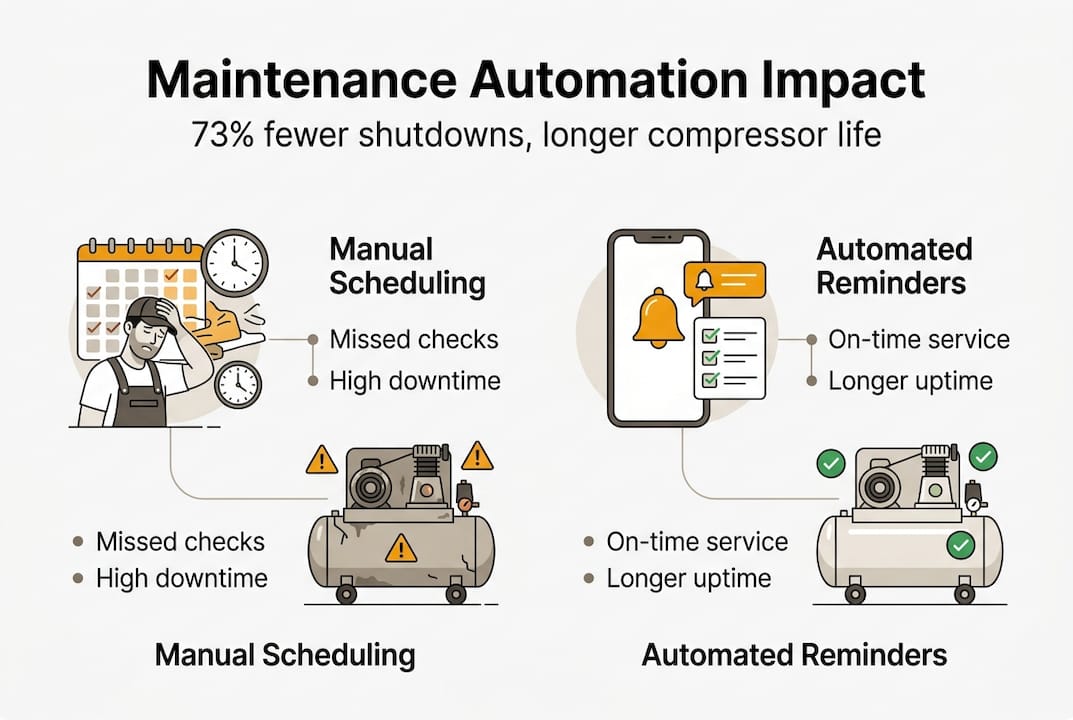
The numbers tell a clear story. Equipment life extends by 40% and emergency shutdowns drop by 73% when maintenance intervals are followed consistently. That is not a marginal improvement. That is a fundamental shift in how reliably your equipment performs across a full service season.
So why do so many businesses still fall behind? The most common causes are entirely preventable:
- Clogged intake filters: Dust and debris restrict airflow, forcing the compressor to work harder and overheat.
- Oil degradation: Lubricant breaks down over time, increasing friction and wear on internal components.
- Loose belts and fittings: Vibration gradually loosens connections, leading to pressure drops and mechanical stress.
- Missed drain cycles: Moisture accumulates in the tank, accelerating internal corrosion.
- Ignored service logs: Without a reliable tracking system, intervals slip and no one notices until failure occurs.
Each of these issues is straightforward to address when caught early. Left unchecked, any one of them can cause a compressor to fail mid-job.
"Consistent, scheduled maintenance is not optional for high-utilization compressors. It is the single most effective way to protect capital equipment and avoid unplanned downtime."
For teams already using automated HVAC reminders, the transition to compressor-specific alerts is natural. The same logic applies: build the schedule once, let the system enforce it, and redirect your attention to the work itself.
Pro Tip: Adjust your service intervals based on environment and usage. A compressor running eight hours daily in a dusty warehouse needs more frequent filter checks than one used occasionally in a clean residential setting.
Now that we have set the stakes, let us look closer at why staying ahead on maintenance is both urgent and achievable.
What automated reminders do: core features and benefits
Automated reminders are digital tools that send alerts for upcoming, overdue, or custom-scheduled maintenance tasks. They operate within your scheduling software and can notify both your technicians and your customers, removing the burden of manual follow-up entirely.

The contrast with manual scheduling is significant. Here is a direct comparison:
| Factor | Manual scheduling | Automated reminders |
|---|---|---|
| Workflow steps | Multiple manual entries, phone calls, paper logs | Single setup, system manages follow-up |
| Error rate | High (human oversight, missed updates) | Low (rules-based, consistent triggers) |
| Time investment | 30 to 60 minutes per client per cycle | Near zero after initial configuration |
| Customer outcomes | Inconsistent, dependent on staff availability | Reliable, timely, professional communication |
Field service businesses using automated emails for reminders report higher retention rates and a measurable reduction in overdue services. That combination directly improves both revenue predictability and customer satisfaction.
Here is how a typical automated reminder workflow operates within a field service business:
- Input equipment data: Log each compressor's make, model, installation date, and usage profile into your scheduling platform.
- Define service intervals: Set maintenance triggers based on time (every 90 days), usage hours, or both.
- Configure notification rules: Decide who gets notified (technician, customer, or both), when (7 days before, day of), and how (email, SMS, in-app).
- Activate and test: Run a test cycle to confirm alerts fire correctly before going live with your full client list.
- Review and adjust: Monitor completion rates and tweak intervals or notification timing based on real-world feedback.
Pro Tip: For compressors in dusty or high-use environments, set a secondary reminder at a shorter interval. A standard 90-day alert works for typical conditions, but a 45-day trigger for edge-case equipment prevents the failures that catch teams off guard.
When integrated with automated scheduling systems, reminders become part of a broader operational rhythm rather than a standalone task. The result is a service model that runs consistently, regardless of staff turnover or seasonal demand spikes.
Real-world results: downtime reduction and operational gains
Understanding the mechanics of reminders is helpful, but what do they deliver in the field? Here is what real businesses report.
| Metric | Before automated reminders | After automated reminders |
|---|---|---|
| Missed maintenance intervals | 28% of scheduled services | Under 5% |
| Emergency shutdowns per quarter | 9 average | 2 to 3 average |
| Average equipment age at failure | 6.2 years | 9.1 years |
| Technician hours lost to reactive repairs | 14 hours per month | 4 hours per month |
These shifts are not accidental. They reflect what happens when equipment lifespan extends by 40% and emergency shutdowns fall by 73% through consistent, reminder-driven maintenance. Better appointment scheduling efficiency means technicians spend more time on billable work and less time reacting to preventable failures.
"When our reminders went live, the first thing we noticed was how much less time dispatch spent chasing down overdue service calls. The system just handled it."
Operational leaders who have made the switch consistently highlight the same benefits:
- Less interruption: Technicians are not pulled off active jobs to handle emergency compressor calls.
- Higher productivity: Planned maintenance takes a fraction of the time that reactive repairs require.
- Better client loyalty: Customers who receive timely service reminders feel looked after, which builds long-term trust.
- Improved forecasting: Predictable maintenance schedules make parts ordering and staffing far easier to manage.
For teams looking to tighten their operations further, pairing reminders with efficient scheduling tips creates a compounding effect. Fewer emergency calls mean more room in the schedule for planned, profitable work.
Best practices for implementing automated reminders
By now, the benefits are clear. So how can you get started and ensure reminders deliver consistent value?
The setup process does not need to be complicated. Follow these steps to get your system running effectively:
- Choose the right platform: Select scheduling software that supports custom maintenance intervals, multi-channel notifications, and client-level configuration.
- Audit your equipment list: Before importing data, verify that every compressor in your client base is documented with accurate service history.
- Segment your clients: Group equipment by usage intensity, environment type, and service frequency so you can apply the right reminder rules to each group.
- Set escalation alerts: If a reminder goes unacknowledged, trigger a follow-up notification to the technician or service manager.
- Review completion data monthly: Track how many reminders convert to completed services and adjust timing or messaging where drop-off occurs.
Reminder systems can dynamically adjust frequencies for dusty or high-use jobs, ensuring compressors in demanding environments receive the attention they need without manual recalculation. Pairing this with maintenance scheduling software gives you a scalable foundation that grows with your client base.
Avoid these common pitfalls:
- Outdated client lists: Reminders sent to old contacts waste time and erode trust. Audit your database every quarter.
- Reminder fatigue: Too many alerts desensitize customers and technicians. Stick to meaningful, well-timed notifications.
- One-size-fits-all intervals: A residential unit and a commercial compressor running 10 hours daily do not share the same maintenance needs. Customize accordingly.
- No human review step: Automated does not mean invisible. Assign someone to review completion rates and flag anomalies.
Pro Tip: Use customer segmentation to send personalized reminders that reference the specific equipment being serviced. A message that names the compressor model and last service date feels far more professional than a generic alert, and customers are more likely to act on it.
The hidden potential (and limits) of automation in service businesses
Conventional wisdom treats automation as a way to reduce workload. Set it up, walk away, and let the system handle things. That mindset produces average results. The field service businesses that see the strongest gains use automated reminders differently. They treat alerts as a trigger for human follow-up, not a replacement for it.
When a reminder fires and a customer responds, that is an opening. A technician who follows up personally, confirms the appointment, and asks about any new concerns turns a routine service call into a relationship-building moment. That is something no algorithm can replicate.
Over-automation creates blind spots. If your system runs without regular human review, you will miss patterns: a compressor that keeps triggering early alerts, a client who never responds, a service interval that consistently leads to failures. Those signals require judgment, not just software.
The strongest approach combines reliable automation for consistency with deliberate human attention for quality. Use reminders to protect your schedule and your equipment. Use your team to protect your client relationships. Scheduling for growth means recognizing that technology and people work best when they support each other, not when one tries to replace the other.
Take action with smart scheduling and reminders
Automated reminders and integrated scheduling give your team the tools to maximize uptime, reduce unexpected costs, and deliver reliable service across every client account. The data is clear, the setup is straightforward, and the operational gains compound over time.
FieldSlot is built specifically for field service professionals who need scheduling and reminder tools that work without complexity. From automated email notifications to real-time calendar sync and route optimization, the platform is designed to help HVAC, plumbing, and electrical teams run tighter operations and capture more jobs. Explore FieldSlot online booking to see how it fits your workflow and start reducing downtime today.
Frequently asked questions
How do automated reminders adjust for compressors in dusty or high-use environments?
Automated systems track usage conditions and apply more frequent maintenance alerts for compressors in harsher settings, ensuring filter and oil changes happen before problems develop rather than after.
What measurable results can I expect from using automated reminders?
Businesses typically see up to 40% longer equipment life and 73% fewer emergency shutdowns when automated maintenance reminders are consistently applied.
Can automated reminders help retain field service customers?
Yes. Automated service emails reduce overdue visits and keep customers informed, which builds trust and improves long-term retention rates.
What is the risk of relying only on manual compressor maintenance scheduling?
Manual tracking depends entirely on staff consistency and is highly prone to human error, leading to missed service intervals, unexpected equipment failures, and dissatisfied customers.