TL;DR:
- Effective scheduling tools must include route optimization, real-time updates, and mobile access for field techs.
- All-in-one platforms and FSM software suit larger or fleet-based mobile oil change operations.
- AI-driven scheduling significantly increases jobs per day and boosts revenue through smarter planning.
Booking a mobile oil change sounds simple until you're dealing with double-bookings, technicians stuck in traffic, and customers calling to ask where their appointment went. Without the right scheduling tool, even a well-run mobile oil change operation can lose jobs and revenue fast. This guide walks you through the main types of scheduling tools available, what separates a good one from a great one, and how to match the right solution to your specific operation. Whether you run a single van or a growing fleet, the right platform can cut wasted time and increase the number of jobs you complete each day.
Table of Contents
- Key criteria for selecting a scheduling tool
- All-in-one auto repair management platforms
- Field service management (FSM) software-software)
- AI-powered and dynamic scheduling systems
- Comparison: Which scheduling tool fits your mobile oil change needs?
- Why the best tool for mobile oil changes is more than just a calendar
- Book more mobile oil changes with advanced scheduling
- Frequently asked questions
Key Takeaways
| Point | Details |
|---|---|
| Prioritize route optimization | Scheduling tools that minimize travel ensure more jobs in less time. |
| AI boosts bookings and revenue | AI-driven scheduling can lead to 40-60% more bookings and higher profits. |
| Choose tools suited for mobile ops | FSM and dynamic systems offer features generic appointment apps often lack. |
| Reminders reduce no-shows | Automated communication helps ensure clients keep their oil change appointments. |
Key criteria for selecting a scheduling tool
Not all scheduling tools are built for the road. Mobile oil change services have unique demands that a standard appointment calendar simply cannot handle. You need to account for travel time between jobs, variable service durations, real-time availability updates, and customer communication, all while your technicians are out in the field.
Here are the must-have features to look for:
- Real-time availability updates so customers only book open slots
- Route optimization to minimize drive time between jobs
- Automated customer reminders to reduce no-shows
- Mobile app access so technicians can view and update jobs on-site
- Integration with payments and inventory for end-to-end workflow
- Dispatch tracking so you always know where your team is
Common pain points in mobile oil change scheduling include double-booking the same technician, poor route planning that wastes fuel and time, and customers who forget appointments. Mobile-first apps for on-site scheduling avoid double-bookings and enable real-time updates that keep both technicians and customers informed.
When evaluating tools, also consider how well they handle efficient scheduling features like buffer times between appointments and geographic service area controls. These details matter more than most operators realize.
Pro Tip: Prioritize tools that include a mobile app and live dispatch tracking. Your technicians need to access their schedule, update job status, and navigate to the next customer without calling the office.
All-in-one auto repair management platforms
All-in-one platforms are designed to manage every aspect of your auto service business from a single interface. Scheduling is just one piece. These platforms also handle invoicing, customer records, inventory, and reporting.

Major platforms in this category include AutoLeap, Shopmonkey, Orderry, and OctopusPro. Each offers a full suite of tools aimed at reducing the administrative burden on shop owners and mobile operators alike.
Key features of all-in-one platforms:
- Integrated scheduling with customer history
- Mobile access for technicians in the field
- Invoicing and payment processing
- Inventory tracking and parts management
- Reporting dashboards for business performance
All-in-one platforms like AutoLeap offer integrated scheduling with invoicing, inventory, and customer management. AutoLeap ranked 8.7/10 overall for scheduling capability in multiple comparisons, making it one of the stronger options for mobile operations that want everything under one roof.
For streamlined scheduling examples that show how integrated tools reduce admin time, the pattern is consistent: fewer manual steps means more jobs completed.
| Feature | All-in-one platforms | Basic booking tools |
|---|---|---|
| Scheduling | Full, integrated | Basic |
| Invoicing | Built-in | Separate tool needed |
| Mobile app | Yes | Sometimes |
| Inventory | Yes | No |
| Reporting | Advanced | Minimal |
The main drawback is cost and complexity. These platforms carry higher subscription fees and may include features you never use. They work best for larger teams that need full-suite integration and want a single vendor for all their operational needs.
Field service management (FSM) software
FSM software takes a different approach. Instead of managing every aspect of an auto business, FSM tools focus specifically on dispatch, job assignment, and field operations. For mobile oil change services with multiple vans and high daily job volume, this distinction matters.
FSM tools emphasize dispatch efficiency, real-time GPS tracking, automated job assignment, and route optimization that are crucial for mobile services. These capabilities directly address the core challenge of getting the right technician to the right location at the right time.
Standout FSM features for mobile oil change:
- Automated dispatch based on technician location and availability
- Real-time GPS tracking for the entire fleet
- Dynamic job reassignment when schedules change
- Route optimization to reduce travel between stops
- Customer notifications triggered by job status changes
"For dispatch-heavy mobile operations, FSM software is the clearest path to operational efficiency. Integration with payments and inventory turns it into a near-complete solution."
For route optimization benefits that translate directly to more jobs per day, FSM tools consistently outperform general booking platforms. Reducing unnecessary travel by even 15 minutes per job adds up quickly across a full day's schedule.
| FSM capability | Impact on mobile oil change |
|---|---|
| Real-time GPS | Accurate ETAs for customers |
| Auto dispatch | Faster job assignment |
| Route optimization | Less fuel, more jobs |
| Status notifications | Fewer inbound customer calls |
For fleet service FSM options tailored to automotive mobile services, the market has expanded significantly. FSM tools are best suited for operations running two or more vans with consistent daily job volume.
AI-powered and dynamic scheduling systems
AI scheduling systems represent the next level of optimization for mobile oil change businesses. These tools go beyond static calendars and manual dispatch by using algorithms to predict job durations, fill scheduling gaps, and dynamically adjust routes in real time.
Here is what AI scheduling covers in practice:
- Predictive job length based on historical service data
- Smart routing that adjusts as new bookings come in
- Automated gap filling to maximize technician utilization
- Dynamic rescheduling when cancellations or delays occur
- Demand forecasting to staff appropriately for peak periods
AI-driven tools use algorithms for scheduling optimization, predictive bay filling, dynamic routing, and automated dispatch. For a service like an oil change that typically runs 30 minutes, AI tools can reduce travel time by 25 to 35 percent by clustering nearby jobs and eliminating routing inefficiencies.
The numbers are compelling. Empirical benchmarks show 25 to 35 percent travel time reduction, 40 to 60 percent more jobs per mechanic per day, and a 30 percent revenue increase with fully optimized tools. These are not theoretical gains. They reflect what happens when scheduling stops being reactive and starts being predictive.
For more AI scheduling insights on how these tools work in field service contexts, the underlying principle is consistent: better data leads to better decisions, and better decisions lead to more revenue.
Pro Tip: Even small single-van operations benefit from AI routing. If your tool can cluster nearby bookings automatically, you can often fit one or two extra jobs into a day without adding a single technician.
For AI scheduling strategies specific to auto repair and mobile services, the guidance consistently points toward tools that handle variable service durations, since not every job takes the same amount of time.
Comparison: Which scheduling tool fits your mobile oil change needs?
Understanding all the options is one thing, but how do you figure out which type fits your business best? The answer depends on your team size, daily job volume, and how much complexity you want to manage.
| Tool type | Best for | Key strength | Main limitation |
|---|---|---|---|
| All-in-one platform | Larger teams, full admin needs | End-to-end management | Higher cost, more complex |
| FSM software | Multi-van fleets, dispatch-heavy ops | Real-time dispatch and GPS | Less focus on invoicing |
| AI/dynamic scheduling | High volume, efficiency-focused ops | Predictive optimization | Learning curve, cost |
| Basic booking tools | Solo operators, low volume | Simple, affordable | No routing or dispatch |
Geographic inefficiency in manual scheduling leads to fewer jobs completed per day. Variable service durations, like a 30-minute oil change versus a longer repair, require flexible tools that can adapt without manual intervention. No-shows are also reduced significantly when reminders are automated.
Here is how to match your situation to the right tool:
- Single van, startup: A basic booking tool or entry-level FSM platform is enough to get organized without overspending.
- Two to five vans: FSM software with dispatch and GPS becomes essential for keeping jobs moving efficiently.
- Five-plus vans, high volume: AI-powered scheduling pays for itself quickly through the additional jobs it enables.
- Full-service mobile operation: An all-in-one platform with FSM integration gives you scheduling plus business management in one place.
For detailed software comparisons that break down features and pricing side by side, the pattern is clear: match the tool to your actual operational complexity, not just your budget. For mechanic tool benchmarks that include real user ratings, FSM and AI tools consistently score higher for mobile-specific use cases.
Why the best tool for mobile oil changes is more than just a calendar
There is a tendency to treat scheduling as a solved problem. You pick a calendar app, block out time slots, and call it done. For mobile oil change services, that approach quietly costs you jobs every single week.
The real complexity of mobile scheduling is not the appointment itself. It is everything around it: the drive to the customer, the buffer needed before the next job, the last-minute cancellation that leaves a gap, and the customer who books online at 9 PM expecting a morning slot. A static calendar handles none of that well.
Operators who switch from basic booking tools to manual vs automated scheduling systems consistently report two things: more revenue and less stress. The revenue comes from fitting more jobs into the same hours. The reduced stress comes from not having to manually juggle routes, reminders, and rescheduling.
The lesson here is to treat your scheduling tool as a growth investment. The right platform does not just organize your day. It actively finds capacity you did not know you had. For a mobile oil change operation, that is the difference between a busy day and a profitable one.
Book more mobile oil changes with advanced scheduling
If you're ready to upgrade how you schedule mobile oil changes, here's your best next step.
FieldSlot is built specifically for field service professionals who need more than a basic calendar. It offers route optimization, automated reminders to cut no-shows, geographic service area controls, and 24/7 online booking through shareable links. Setup takes under five minutes, and your customers can book instantly without back-and-forth calls.
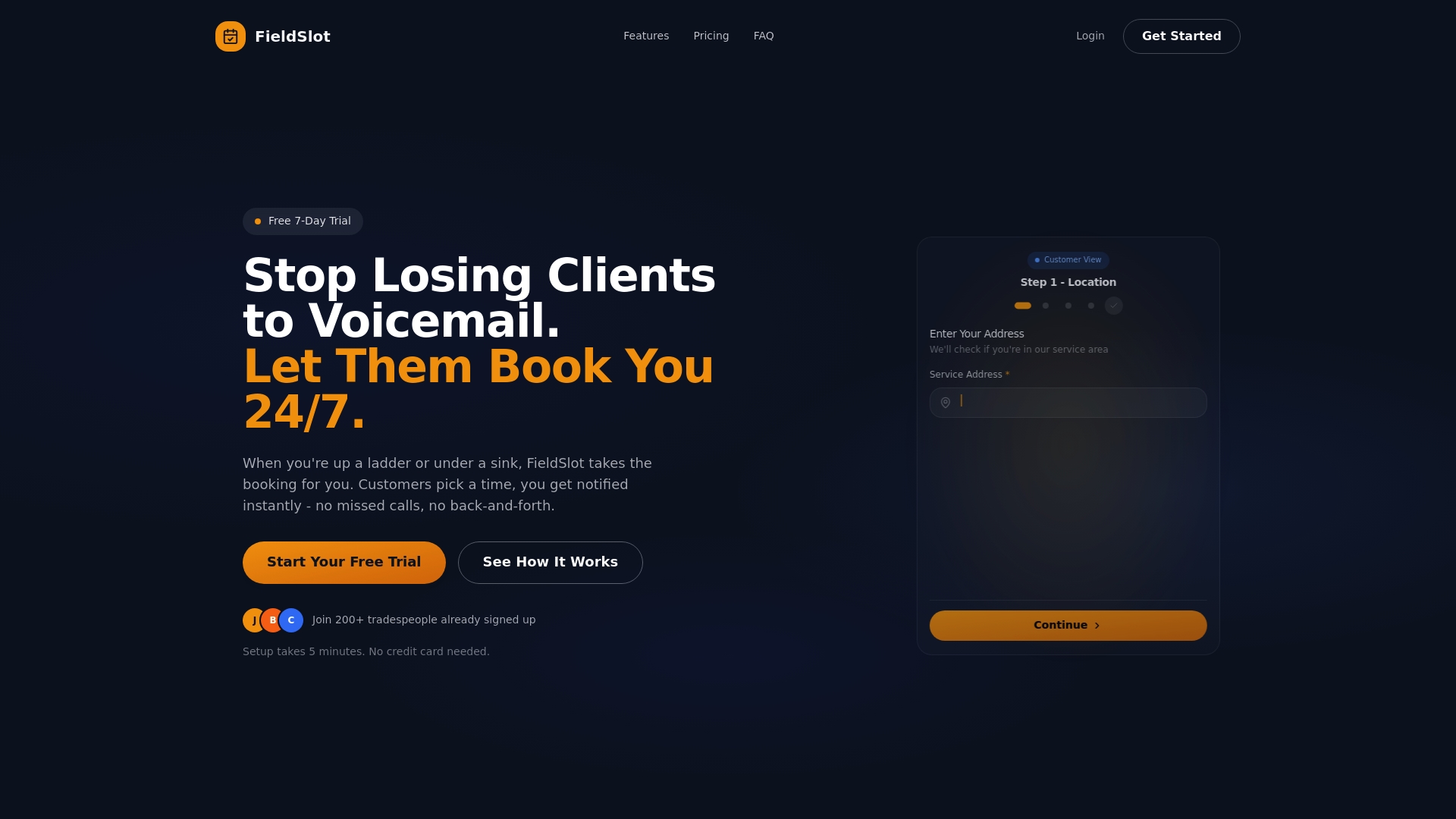
If you want to streamline your bookings and increase the number of jobs your team handles each day, FieldSlot gives you the tools to make that happen without adding administrative overhead. It is practical, mobile-friendly, and designed for the way field service businesses actually operate.
Frequently asked questions
What is the most important feature in a scheduling tool for mobile oil change?
Route optimization and real-time dispatch are the most critical features, as they directly reduce travel time and allow you to fit more jobs into each day.
Can AI scheduling really boost my mobile oil change business revenue?
Yes. Empirical data shows AI scheduling can increase jobs per mechanic per day by 40 to 60 percent and boost revenue by up to 30 percent through smarter routing and gap elimination.
Do general appointment booking tools work for mobile oil change?
They work at a basic level, but FSM tools are better suited for mobile operations because they handle route planning, dispatch, and real-time job updates that generic booking tools cannot manage.
How can scheduling tools reduce customer no-shows?
Automated reminders and confirmations built into most scheduling platforms significantly lower no-show rates by keeping customers informed and accountable before their appointment.