
TL;DR:
- Automating scheduling significantly reduces no-shows, improves efficiency, and increases revenue.
- Key automation functions include AI dispatching, route optimization, automatic quoting, and reminders.
- Adopting automation leads to measurable business gains and competitive advantages over manual scheduling.
Manual scheduling has long been treated as an unavoidable cost of running a windshield repair or replacement business. That assumption is expensive. Automation in scheduling delivers significant efficiency, revenue, and no-show reductions that are proven by real field results, even for small regional teams. This guide breaks down what scheduling automation actually means for windshield technician operations, the measurable benefits you can expect, and a practical roadmap for putting it to work in your business. If you are losing jobs to slow quoting, burning admin hours on callbacks, or watching technicians crisscross the same zip code, this is worth reading carefully.
Table of Contents
- Why manual scheduling holds businesses back
- Core components of automation in windshield technician scheduling
- Business results: Measurable gains from automation
- Implementation tips and keys to successful adoption
- The invisible ROI: Why automation in windshield scheduling is a non-negotiable edge
- Next steps: Automate your windshield technician scheduling with FieldSlot
- Frequently asked questions
Key Takeaways
| Point | Details |
|---|---|
| Automation replaces manual chaos | Switching to automation eliminates admin overload and reduces costly errors in scheduling. |
| Dramatic business gains | Revenue, productivity, and client satisfaction increase measurably after adopting automated scheduling. |
| Simple steps for adoption | Start with a pilot, train staff, and measure improvements for a smooth rollout. |
| Even small teams benefit | Automation scales results for businesses of any size, without the need to hire more technicians. |
Why manual scheduling holds businesses back
Running a windshield service business on spreadsheets, phone calls, and sticky notes is not just inefficient. It is actively costing you money in ways that are easy to overlook until the month-end numbers tell a different story.
Manual scheduling demands constant administrative attention. Someone has to take the call, check technician availability, confirm the appointment, send a reminder (if it happens at all), and reroute a tech when a job runs long. That chain of tasks eats hours every single day. When one link breaks, a customer gets no reminder, a tech shows up to an empty driveway, and the company absorbs the cost.
Manual dispatch leads to unpredictable costs, inefficient job allocations, and missed revenue. These are not theoretical risks. They are recurring patterns in businesses that rely on human coordination for every scheduling decision.
Here is a quick look at where manual scheduling bleeds money:
- No-shows and cancellations: Without automated reminders, no-show rates in glass repair services typically run between 25% and 35%.
- Dispatcher bottlenecks: Every rescheduled job or new booking requires a dispatcher to stop other work and intervene manually.
- Inefficient routing: Techs traveling across town for one job, then back across town for the next, waste fuel and time that could serve an additional customer.
- Slow quoting: Customers who wait hours for a quote often call a competitor who responds in minutes.
- Hidden errors: Double bookings, missed appointments, and incorrect job assignments happen more often than most owners realize.
"Most businesses underestimate the hidden costs of manual scheduling. A delayed estimate does not just slow one job. It can cost you the customer entirely."
Pro Tip: Track the number of calls your admin team handles per booked job. If it takes more than two touches to confirm a single appointment, you are overpaying for scheduling. Understanding the difference between manual vs automated scheduling is the first step toward fixing it.
The good news is that every one of these pain points has a direct automated solution. The next section explains exactly what that looks like.
Core components of automation in windshield technician scheduling
Automation is not a single feature. It is a set of connected functions that replace the most time-consuming and error-prone parts of your scheduling workflow. Understanding each component helps you evaluate which tools will have the biggest impact on your operation.
Here are the four core functions that make up a modern automated scheduling system for windshield technicians:
- AI-powered dispatch: The system matches incoming jobs to the right technician based on skills, location, and current workload. No dispatcher required for routine assignments.
- Intelligent route optimization: The software calculates the most efficient travel sequence for each technician's daily job list. Drive time savings with automation can reach up to 25%, which directly translates to more completed jobs per shift.
- Automated quoting: When a customer submits a service request, the system generates and sends a quote automatically, cutting response time from hours to minutes.
- Automated reminders: Appointment confirmations and reminders go out by email or SMS without any manual effort, keeping customers informed and reducing last-minute cancellations.
A real-world example of this working at scale comes from the Carglass automation case study, which demonstrated how integrating automated logistics and dispatch reduced errors and improved throughput across a large glass repair network.

The table below summarizes each component and its measurable impact:
| Automation component | Primary function | Measurable impact |
|---|---|---|
| AI dispatch | Job-to-tech matching | Dispatch time reduced by up to 85% |
| Route optimization | Travel sequence planning | Travel time reduced by up to 25% |
| Automated quoting | Instant client responses | Quote-to-booking conversion improves |
| Automated reminders | Appointment confirmations | No-show rates drop to 5-10% |
| Real-time schedule updates | Dynamic rescheduling | Admin overhead reduced by up to 60% |
AI-driven dispatch, intelligent routing, automated quoting, and reminders are the key functions that separate a modern scheduling system from a glorified digital calendar. Together, they create a workflow where the majority of scheduling decisions happen automatically, and your team focuses on delivering service rather than coordinating it. For a broader look at what these tools can do across field service operations, field service scheduling software offers a useful reference point.
Business results: Measurable gains from automation
The operational case for automation is clear. But what do the actual business results look like? The numbers are more compelling than most owners expect.
Empirical benchmarks across glass repair operations show a 25-40% revenue increase, no-show rates reduced by up to 30 percentage points, dispatch time cut by 80-85%, admin overhead down 60%, and crew utilization up by more than 20%.
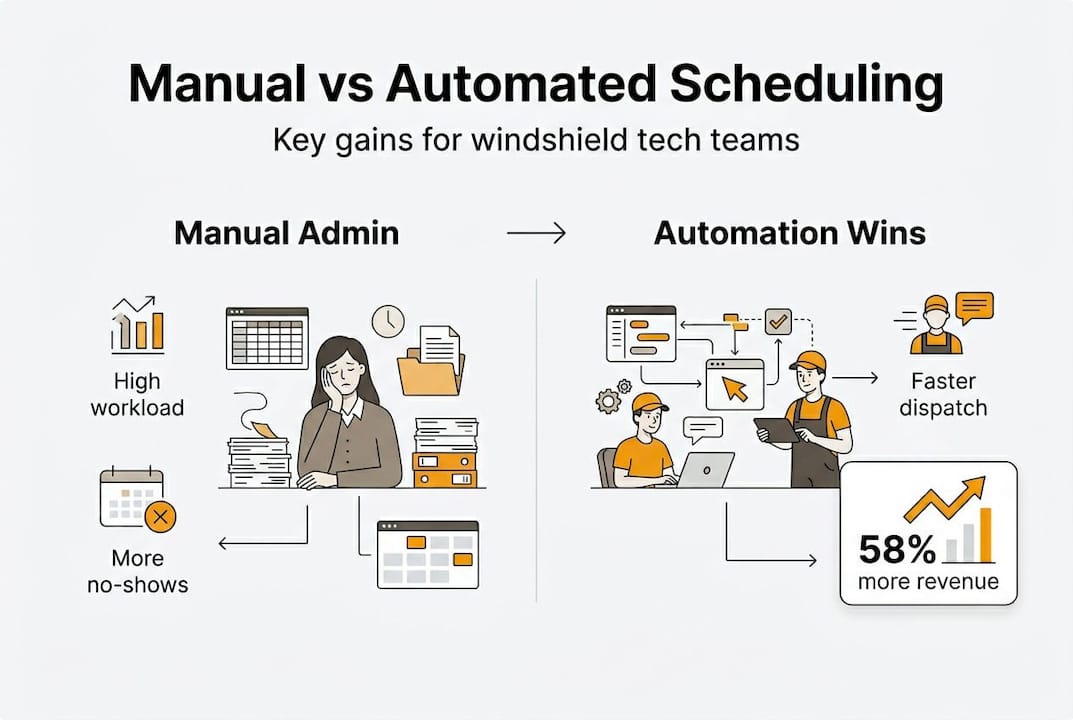
The comparison below shows what these shifts look like side by side:
| Metric | Manual scheduling | Automated scheduling |
|---|---|---|
| No-show rate | 25-35% | 5-10% |
| Dispatch time per job | 15-25 minutes | 2-4 minutes |
| Admin hours per week | High (8-15 hrs) | Low (2-4 hrs) |
| Technician utilization | 60-70% | 80-90% |
| Annual revenue growth | Baseline | 25-58% increase |
One regional glass repair firm increased annual revenue by 58% through automation without adding a single technician to the payroll. That is the kind of outcome that reframes how you think about software investment.
Here are the top business gains that windshield service companies report after adopting scheduling automation:
- More jobs per technician per day due to optimized routing and faster dispatch
- Lower operational costs from reduced admin time and fuel savings
- Higher client satisfaction scores from faster quotes and reliable reminder communications
- Fewer scheduling conflicts and virtually no double bookings
- Scalable capacity without proportional headcount growth
For more context on how efficient scheduling strategies translate to revenue, the patterns are consistent across field service verticals. Windshield services benefit especially because technician time is the primary cost driver, and routing efficiency directly controls how many jobs fit into a workday.
Implementation tips and keys to successful adoption
Knowing the benefits is one thing. Getting your team to actually use a new system effectively is another challenge entirely. Most automation rollouts that underperform do so because of avoidable mistakes during setup and training.
The most common reasons automation fails to deliver its full potential include:
- Skipping structured staff training and assuming the software is self-explanatory
- Entering incomplete or inaccurate service area and technician skill data at setup
- Underutilizing features (routing, reminders) and continuing to schedule manually out of habit
- Setting the system up once and never reviewing or adjusting configurations as the business changes
A structured adoption process makes a significant difference. Here is a straightforward checklist:
- Assess your current workflow: Map out every manual step in your scheduling process before selecting a platform.
- Choose the right platform: Match features to your actual needs, prioritizing dispatch, routing, and reminders as non-negotiable.
- Train your staff before going live: Invest time in hands-on training so your team understands the system before customers experience it.
- Run a pilot with one crew: Test the system with a small group, collect feedback, and resolve friction before rolling out company-wide.
- Set measurable goals: Define what success looks like (no-show rate, jobs per day, admin hours) and review them monthly.
- Optimize continuously: Review routing rules, service zones, and reminder timing every quarter to keep the system performing well.
Initial cost and training are the most cited adoption hurdles, but the consensus across the industry strongly supports automation's long-term benefits.
Pro Tip: Before full rollout, run your automated system in parallel with your existing process for two weeks using one pilot crew. This lets you catch edge cases and build staff confidence without disrupting active customers. Pair this with no-show reduction strategies to maximize your reminder setup from day one.
Automation is not a set-and-forget tool. The businesses that see the strongest results treat their scheduling platform as an active operational asset, revisiting configurations as their service area and team evolve.
The invisible ROI: Why automation in windshield scheduling is a non-negotiable edge
Most conversations about scheduling automation focus on the metrics you can measure immediately: fewer no-shows, faster dispatch, more revenue. Those outcomes matter. But there is a layer of return on investment that rarely gets discussed, and it may be just as valuable over time.
Consider what it costs your business when your dispatcher is managing a queue of inbound calls, rescheduling conflicts, and manual confirmations every morning. That is not just admin time. It is mental bandwidth, staff morale, and the probability of errors increasing under pressure. Automation removes that daily burden, and the effect compounds over months and years.
Automation shifts reactive manual chaos to proactive efficiency, generating significant gains per technician. The businesses that are slow to adopt are not just leaving money on the table today. They are allowing competitors to build operational advantages that become harder to close the longer they wait.
The current technology landscape removes the excuse of complexity or cost. Platforms designed for boosting jobs with software are affordable, scalable, and built for non-technical users. Waiting for a perfect moment to automate is a strategy that consistently works against business growth.
Next steps: Automate your windshield technician scheduling with FieldSlot
Every efficiency gain described in this guide, from faster dispatch to higher technician utilization, becomes accessible when you move to the right scheduling platform. FieldSlot is built specifically for field service businesses like yours, with tools that activate these results quickly.
With FieldSlot, you get 24/7 online booking, automated appointment reminders, real-time calendar sync, and route optimization built into one platform. Setup takes under five minutes, and the system is designed so your team can use it without technical training. If your goal is to serve more customers per day, reduce admin overhead, and eliminate costly no-shows, FieldSlot gives you a direct path to get there. Explore how the platform works and see which plan fits your business size and service area.
Frequently asked questions
What specific scheduling tasks can automation handle for windshield technicians?
Automation covers dispatch, routing, quoting, reminders, and scheduling updates without requiring manual input at each step. This means jobs get assigned, routes get planned, and customers stay informed automatically.
How much can automation reduce missed appointments or no-shows?
No-show rates decrease from 25-35% down to 5-10% with consistent automated reminders and confirmation workflows. That reduction alone can recover significant revenue each month.
Do small glass repair businesses benefit as much as large ones from automation?
Yes. Small regional firms have seen 58% annual revenue growth through automation without adding staff. The efficiency gains scale proportionally regardless of fleet size.
What are the main challenges when moving to automated scheduling?
Implementation costs and training are the initial hurdles most businesses face, but the long-term savings and simplicity of modern platforms make the transition worthwhile within weeks.