
TL;DR:
- Automated booking significantly increases job completion rates and reduces service costs.
- It streamlines scheduling, minimizes missed calls, and optimizes technician routes.
- Proper implementation enhances efficiency, customer satisfaction, and provides valuable business data insights.
Field service companies that adopt automated booking see up to 26% in service cost savings within their first quarter, yet most small trade businesses still rely on phone calls and paper calendars to manage their jobs. If you run a plumbing, electrical, HVAC, or locksmith operation, you already know the frustration: missed calls, double-booked slots, and technicians driving across town for jobs that could have been clustered together. Automated booking is not a luxury reserved for large enterprises. It is a practical, accessible tool that small trade businesses can deploy quickly to capture more jobs, reduce wasted time, and deliver a better customer experience. This article breaks down exactly how it works and what results you can expect.
Table of Contents
- Why traditional booking systems hold you back
- What is automated booking: Key features and how it works
- The business impact: Revenue, efficiency, and customer satisfaction
- Pitfalls to avoid with automated booking adoption
- How smart automation is reshaping the future of field service
- Get started with automated booking today
- Frequently asked questions
Key Takeaways
| Point | Details |
|---|---|
| Boost business growth | Automated booking can increase revenue by up to 40% and job volume by 30%. |
| Reduce costly inefficiencies | Switching from manual to automated booking cuts travel time and costly scheduling mistakes. |
| Enhance customer satisfaction | Automation helps ensure more on-time appointments and higher completion rates, fueling positive reviews. |
| Avoid common pitfalls | Proper training and workflow alignment are essential for successfully adopting automation. |
Why traditional booking systems hold you back
Most small field service businesses start out managing appointments the same way: a whiteboard, a shared spreadsheet, or a phone-based back-and-forth with customers. It works at first. Then the business grows, the jobs pile up, and the cracks start to show.
The core problem with manual scheduling is that it depends entirely on human availability. A customer calls at 7 p.m. on a Friday and gets no answer. They call your competitor, who has online booking, and the job is gone. You never even knew it was available.
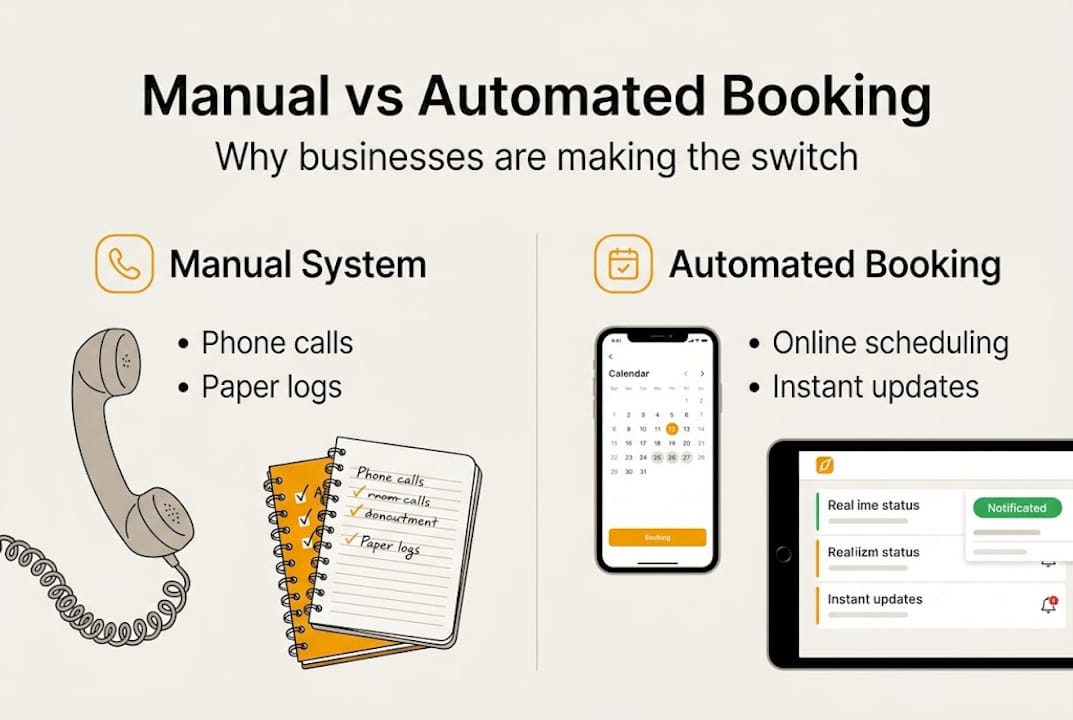
Manual scheduling leads to missed appointments and inefficient route planning, both of which directly cut into your revenue and your team's productivity. The benefits of automation in appointment management become clear the moment you see how much time and money manual processes waste every single week.
Here are the most common pain points trade businesses face with traditional booking:
- Missed calls and lost jobs: Customers who can't reach you immediately will book elsewhere.
- Double bookings: Without a live, synced calendar, two techs can end up assigned to the same slot.
- Inefficient routing: Dispatchers assign jobs without visibility into technician location or travel time.
- No-shows from customers: Without automated reminders, customers forget appointments, leaving techs with wasted drive time.
- Administrative overload: Someone has to manually enter every booking, confirmation, and change.
"The businesses that struggle most with growth aren't short on skills or customers. They're short on systems. Manual scheduling is the single biggest operational bottleneck we see in small field service companies."
Each of these issues compounds over time. A no-show here, a double booking there, and suddenly you're losing thousands of dollars a month without a clear cause. The fix is not hiring more staff to manage the calendar. It's replacing the manual process with a system that runs itself.
What is automated booking: Key features and how it works
Automated booking, in a field service context, means giving customers the ability to self-schedule appointments online while the system handles confirmation, reminders, calendar updates, and job assignment automatically. No phone tag. No manual data entry. No gaps in coverage after business hours.
The scheduling software benefits go well beyond simple convenience. Top performers boost job completion rates to 88% with automated tools, compared to significantly lower rates among businesses still using manual methods.
Here are the key features that make automated booking work for trade businesses:
- 24/7 online booking: Customers book at any time via a shareable link, without needing to call.
- Real-time calendar sync: Appointments sync instantly with Google Calendar or Microsoft Outlook, eliminating double bookings.
- Automated reminders: Email or SMS reminders go out before each appointment, reducing no-shows.
- Route optimization: The system groups jobs by location to minimize travel time between appointments.
- Service area control: You define the geographic zones where you accept bookings, preventing unprofitable travel.
- Smart travel buffers: Time is automatically blocked between jobs to account for realistic travel and setup time.
These features do not operate in isolation. They work as a connected system. A customer books online, the calendar updates instantly, a reminder goes out automatically, and the technician's route is already optimized for the day. Nothing falls through the cracks.
| Workflow step | Manual process | Automated booking |
|---|---|---|
| Customer books appointment | Phone call during business hours | Online, 24/7, self-service |
| Calendar update | Manual entry, risk of error | Instant, real-time sync |
| Appointment reminder | Staff calls or texts customer | Automated email or SMS |
| Route planning | Dispatcher estimates manually | System-optimized by location |
| No-show management | Reactive, after the fact | Proactive reminders reduce risk |
| Reporting | Manual tracking, often skipped | Automatic data capture |
Pro Tip: When evaluating automated booking tools, prioritize ones that integrate directly with your invoicing software and CRM. A booking system that connects to your billing workflow means less double-entry and faster payment collection after each job.
The business impact: Revenue, efficiency, and customer satisfaction
The numbers behind automated booking are hard to ignore. Businesses see 20-30% more jobs per day and up to 26% in service cost savings after making the switch. For a small trade business running five to ten jobs a day, that kind of lift is transformative.

The gains come from multiple directions at once. You take on more jobs because your calendar is always open. You spend less time on admin. Your techs travel smarter. And your customers get a better experience, which drives repeat business and positive reviews.
| Metric | Before automation | After automation |
|---|---|---|
| Jobs completed per day | 5-6 | 7-9 |
| Average travel time per job | 35-45 minutes | 20-30 minutes |
| Customer no-show rate | 15-20% | 5-8% |
| Admin time per booking | 10-15 minutes | Under 1 minute |
| Customer satisfaction score | Moderate | High |
Here is how the improvement chain works in practice:
- Customer books instantly online. No waiting for a callback, no friction. The easier it is to book, the more customers follow through.
- Reminder goes out automatically. The customer gets a confirmation and a reminder before the appointment, reducing the chance they forget or cancel last minute.
- Technician gets an optimized route. Less windshield time means more jobs in the same workday, which directly increases revenue per technician.
- Job is completed on time. Arriving on schedule builds trust. Customers who have a smooth experience leave better reviews.
- Reviews attract more customers. A higher rating on Google or Yelp brings in new leads without additional marketing spend.
You can explore more detail on optimizing scheduling for efficiency and the key automation benefits that drive these outcomes. The pattern is consistent: businesses that automate scheduling grow faster and operate leaner.
Pitfalls to avoid with automated booking adoption
Automated booking delivers strong results, but only when it's implemented correctly. Many small businesses rush the rollout, skip training, or choose tools that don't match how they actually operate. The result is a system that creates new problems instead of solving old ones.
Top-performing companies use automation to scale knowledge and reduce errors across their workforce. That means the tool is only as effective as the team using it and the processes surrounding it.
Here are the most common mistakes to avoid:
- Skipping staff training: Your technicians and office staff need to understand how the new system works. If they don't trust it or know how to use it, they'll work around it, which defeats the purpose.
- Choosing the wrong tool for your workflow: A booking system built for salons or medical offices won't account for travel time, service area restrictions, or job complexity. Use a tool designed specifically for field service.
- Underutilizing available features: Many businesses turn on basic booking but ignore route optimization, service area controls, or automated reminders. These features are where the real efficiency gains live.
- Poor customer communication during the transition: If you switch systems without telling your customers, they may try to book the old way and get confused. Send a simple message explaining the new process.
- Not tracking performance after launch: Without measuring no-show rates, jobs per day, and customer satisfaction before and after, you won't know what's working or what needs adjustment.
- Going too big too fast: Trying to automate every part of your operation at once is overwhelming. Start with appointment booking and reminders, measure the results, and then expand.
For practical guidance on managing the transition, the tips on efficient client scheduling walk through common scenarios that trade businesses face when moving away from manual systems.
Pro Tip: Start with one technician or one service type when rolling out automated booking. Measure the improvement in jobs completed and no-show rates over 30 days, then expand to the rest of your team. A phased rollout gives you real data and builds confidence before you go all in.
How smart automation is reshaping the future of field service
Most conversations about automated booking focus on the immediate wins: fewer no-shows, more jobs, less admin work. Those gains are real and worth pursuing. But we think the bigger story is what automation makes possible over time.
When your scheduling runs itself, you get something more valuable than saved time. You get data. Every booking, cancellation, route, and customer interaction becomes a data point. Over months, that data tells you which services are most profitable, which areas generate the most demand, and where your team's capacity is being wasted.
The transformative power of online booking isn't just about replacing phone calls. It's about building a business that makes smarter decisions because it has better information.
Small trade businesses that resist automation won't just fall behind on efficiency. They'll fall behind on insight. Competitors using automated tools will know their numbers. They'll adjust pricing, expand service areas, and allocate technicians based on real demand patterns. Businesses still working from a whiteboard won't have that visibility.
Automation isn't a shortcut. It's the foundation of a more competitive, more resilient field service operation.
Get started with automated booking today
If the gap between where your scheduling is now and where it could be feels large, the good news is that getting started is simpler than most trade business owners expect.
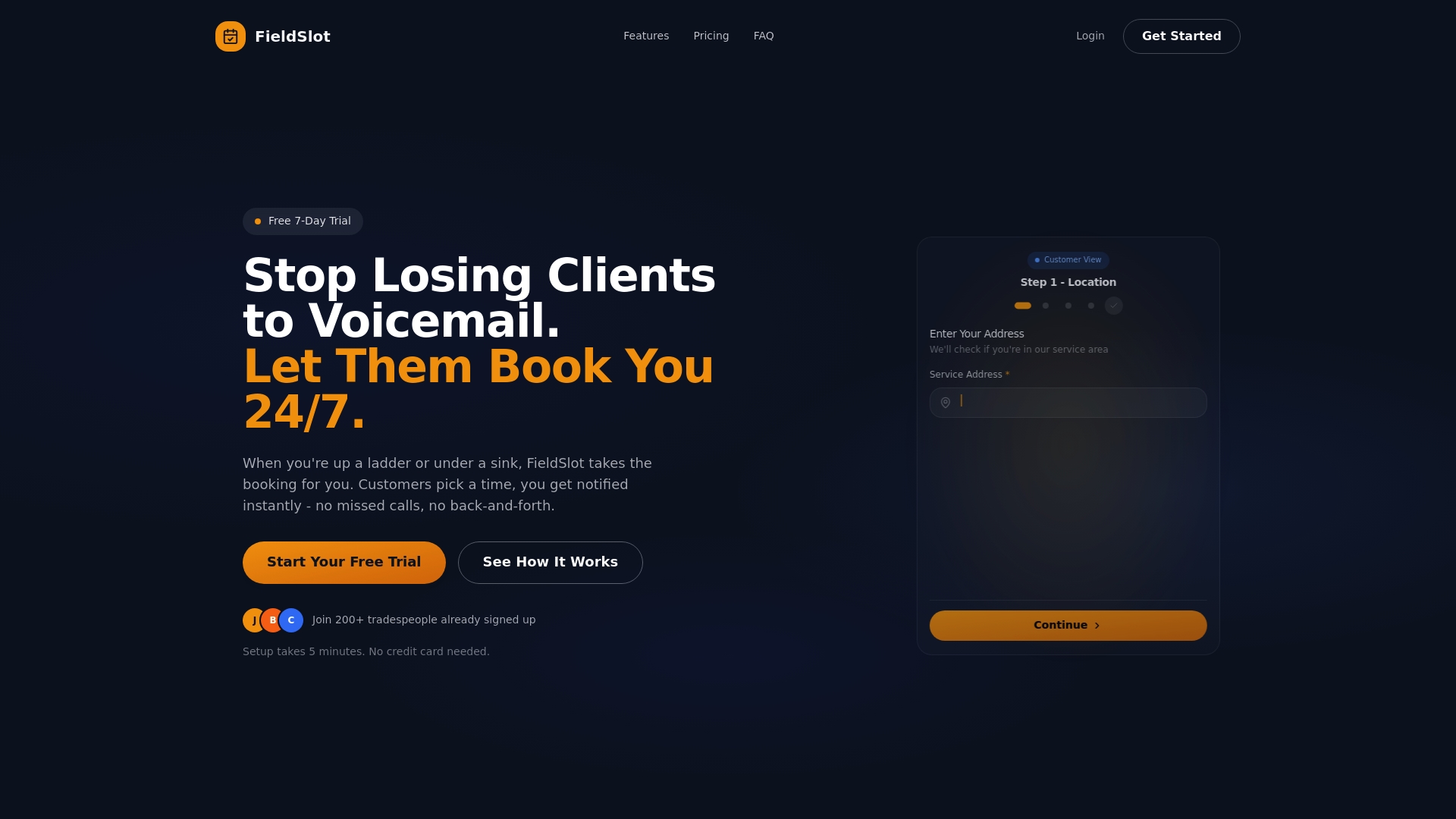
FieldSlot is built specifically for field service professionals like plumbers, electricians, HVAC technicians, and locksmiths. You can set up automated booking in under five minutes, share your booking link with customers immediately, and start capturing jobs around the clock without adding administrative work. Features like route optimization, service area restrictions, and automated reminders are included to help you run a tighter, more profitable operation from day one. If you're serious about growing your business efficiently, FieldSlot gives you the tools to do it without the complexity.
Frequently asked questions
How quickly can small field service businesses see results with automated booking?
Many businesses see a 25-40% revenue boost and 20-30% more jobs completed daily within the first quarter after implementing automated booking tools.
Does automated booking reduce travel time for field technicians?
Yes, route optimization built into automated booking platforms cuts travel time by 10-20% on average by grouping jobs by location and accounting for realistic transit time between appointments.
What is the impact of automation on customer satisfaction in field service?
Top-performing field service companies reach 88% job completion rates through automation, which directly translates to fewer missed appointments and higher customer satisfaction scores.